
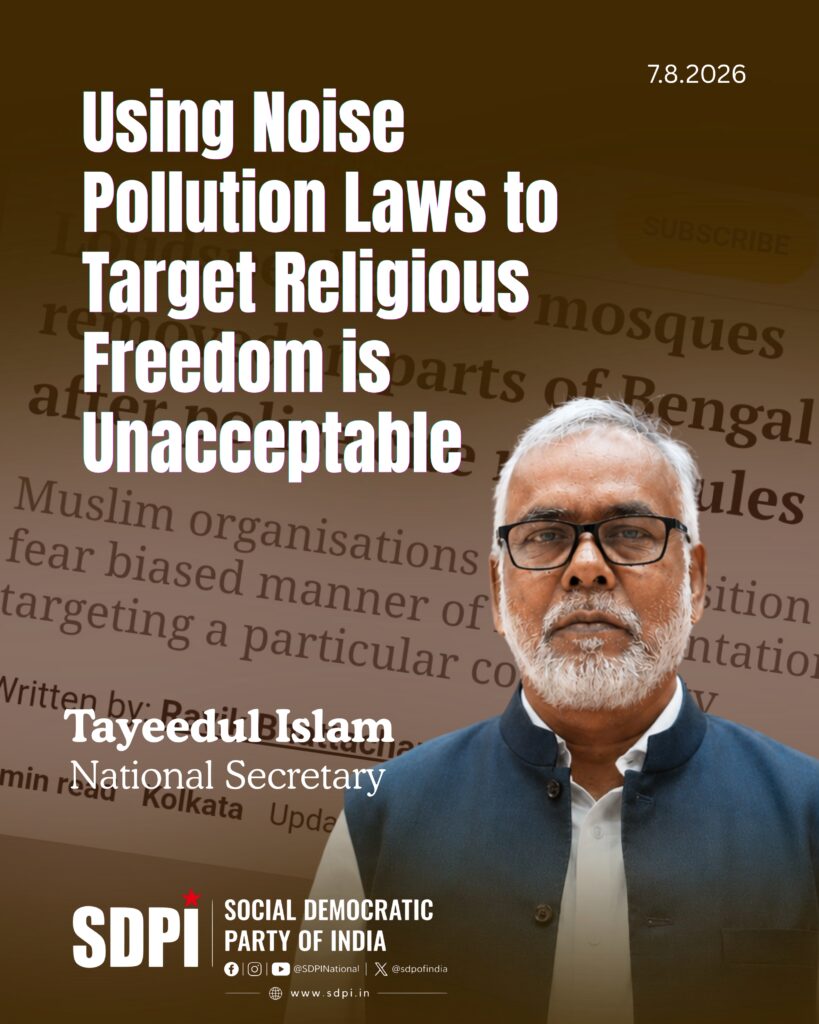
Using Noise Pollution Laws to Target Religious Freedom is Unacceptable
Tayeedul Islam, National Secretary of the Social Democratic Party of India, has strongly condemned the BJP government led by Chief Minister Suvendu Adhikari in West Bengal for what he described as a politically motivated and partisan campaign against religious freedom under the pretext of enforcing noise pollution regulations. The drive, launched immediately after the BJP assumed office in the state, has primarily affected Muslim places of worship. According to official figures released by the government, loudspeakers were removed from 4,203 mosques compared to 1,096 temples. This glaring disparity raises serious questions about the neutrality of the enforcement. Reports that police acted in many places on the basis of verbal instructions without issuing written notices further cast doubt on due process, administrative transparency and the rule of law.
The duty of the police is to uphold the law, not to act outside its framework. If any loudspeaker is found to be in violation of statutory provisions, enforcement must be carried out strictly in accordance with the law and established procedures. The removal of loudspeakers by the police without following due process and relying solely on verbal instructions is arbitrary, legally questionable and inconsistent with the principles of fair administration and the rule of law. The state government must not use existing laws as a cover for discriminatory enforcement. The implementation of any law must fully uphold the constitutional guarantees of equality before the law and freedom of religion under Articles 14 and 25 of the Constitution. Measures that disproportionately affect one particular community undermine constitutional values, erode public confidence in governance and deepen social polarisation. The West Bengal government must immediately end these partisan actions, ensure equal treatment of all religious institutions before the law and cease all measures that infringe upon the constitutional rights of places of worship.

No Comments