
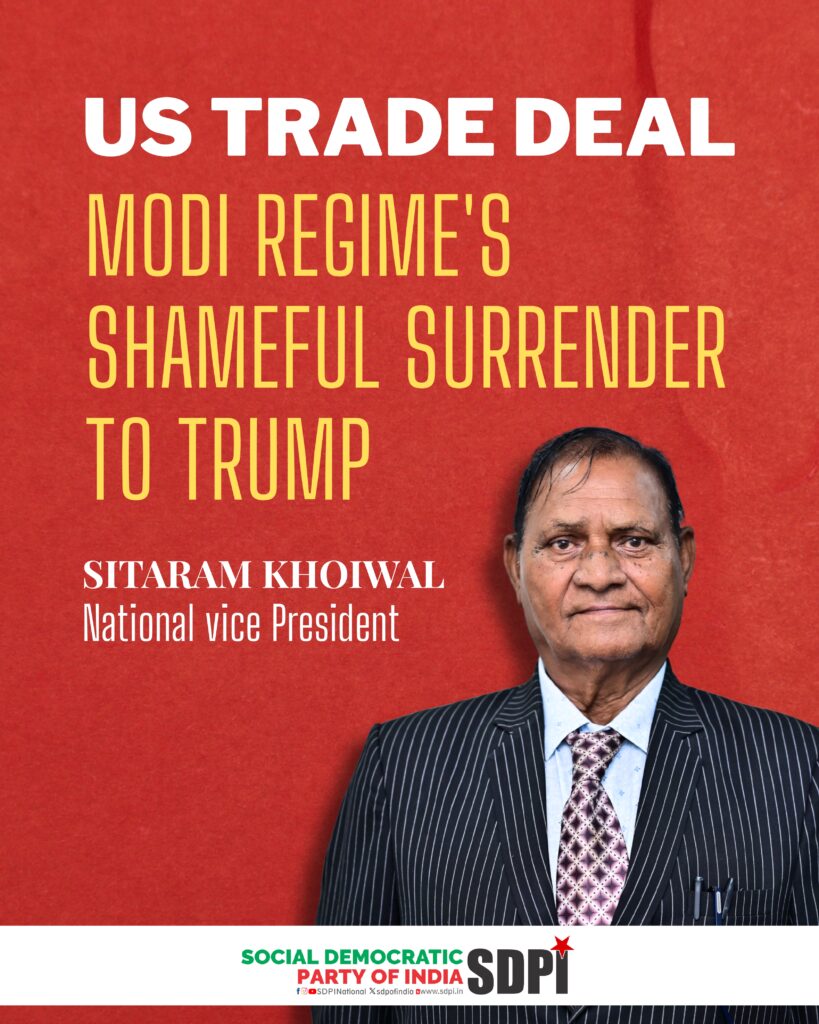
US Trade deal:
Modi Regime’s Shameful Surrender to Trump
Sitaram Khoiwal, national vice president of the Social Democratic Party of India, strongly condemned Modi regime’s recent trade deal with the United States, describing it as a shameful capitulation that undermines India’s sovereignty and economic independence and demands a parliamentary debate on the proposed Indo-US trade deal affecting Indian farmers.
This agreement, hastily announced after a phone call between Prime Minister Narendra Modi and US President Donald Trump, represents a blatant submission to American pressure tactics, forcing India to abandon its strategic autonomy in favor of aligning with Washington’s geopolitical agenda at the expense of our nation’s interests, and the SDPI demands that the government facilitate a constructive debate on this matter on the floor of Parliament. By committing to halt imports of affordable Russian oil, which has been a lifeline for India’s energy needs at discounted rates of around forty to fifty dollars per barrel below market prices, the Modi government is deliberately inviting higher energy costs that will burden ordinary Indians with inflation and increased living expenses, all while shifting to more expensive US supplies that could inflate our import bills by billions annually.
Furthermore, the deal’s massive purchase commitments, potentially exceeding five hundred billion dollars in American goods over coming years, including energy, technology, agriculture, and defense equipment, will exacerbate India’s trade deficit with the United States, flooding our markets with foreign products and threatening the livelihoods of local farmers and manufacturers who already struggle under competitive pressures. Statements and reports by the United States Agriculture Secretary indicate that under the proposed trade agreement, American agricultural products may be allowed to enter the Indian market at zero percent import duty, and if such provisions are accepted, they would have far-reaching and disastrous consequences for Indian agriculture and the livelihoods of millions of farmers. The duty-free import of American products such as cotton, milk and dairy products, pulses, soybeans, maize, nuts including almonds, walnuts, and pistachios, apples, and other fruits would place Indian farmers in a severely disadvantaged position, as Indian agriculture, already grappling with rising input costs, inadequate realization of Minimum Support Price, and market instability, cannot compete with heavily subsidized American agribusiness. This situation recalls the earlier attempt by the BJP government to restructure Indian agriculture through the three farm laws, which were ultimately withdrawn after a historic farmers’ movement, and the re-emergence of such policies through international trade negotiations reflects a continued disregard for farmers’ welfare.
Despite vague assurances of exclusions for sensitive sectors like dairy, the reduction of Indian tariffs to near zero levels opens the door to an influx of US agricultural goods, risking job losses in domestic industries and weakening our self reliance initiatives such as Make in India. This is not a balanced partnership but a one sided concession, where India gains only partial relief from punitive US tariffs reduced to eighteen percent, still higher than pre crisis levels, while surrendering key leverage in global affairs. The opacity surrounding the agreement is equally alarming, with the Modi regime refusing to disclose full details on timelines for the oil shift, specific product lists, or enforcement mechanisms, even as opposition voices demand transparency amid celebrations in pro government media. Reports indicate that negotiations stalled last year because Modi failed to engage directly with Trump, leading to doubled tariffs that crippled Indian exports, and only resumed under duress, possibly influenced by external leverages such as the Adani Group’s ongoing SEC investigations or speculative ties to sensitive US files. This deal erodes India’s longstanding non aligned foreign policy, tilting us dangerously toward the US at the cost of relations with Russia and potentially isolating us in multipolar world dynamics.
The Social Democratic Party of India strongly questions the government’s intent in negotiating such an agreement, highlights the risks faced by small and marginal farmers, and demands complete transparency, insisting that any trade agreement affecting agriculture must be placed before both Houses of Parliament for discussion and democratic scrutiny. Prioritizing corporate and foreign interests at the cost of the rights and survival of India’s farming community amounts to a grave betrayal, and the government must be held accountable and compelled to disclose the exact terms of the proposed agreement.

No Comments