
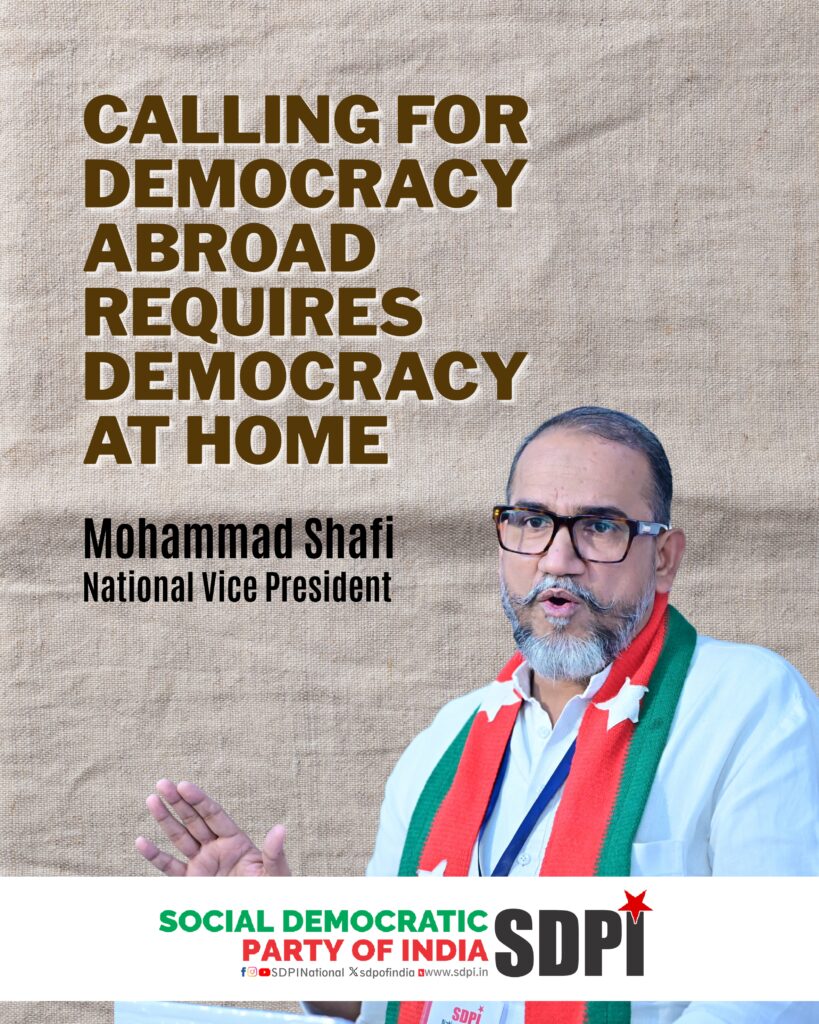
Calling for Democracy Abroad Requires Democracy at Home
Prime Minister Narendra Modi’s recent call for the restoration and protection of democratic governance in Bangladesh has drawn sharp attention to the contrasting reality within India. At a time when democratic rights at home are widely perceived to be under strain, marked by the suppression of opposition voices, the reported misuse of investigative and enforcement agencies for political purposes, and the growing marginalisation of the Muslim minority, such external advocacy raises profound constitutional and moral questions.
The Citizenship Amendment Act provides a fast track to citizenship for non Muslim migrants from Afghanistan, Bangladesh, and Pakistan while explicitly excluding Muslims. The law is discriminatory and inconsistent with the constitutional guarantees of equality and non discrimination. Concerns remain that any future linkage with a nationwide citizenship verification process could disproportionately impact vulnerable Muslim communities lacking formal documentation.
Further deepening anxiety within the community is the Waqf Amendment Act of 2025, which has generated widespread apprehension regarding the protection, administration, and autonomy of waqf properties. The amendments risk increasing state control over religious endowments and potentially undermine long standing legal safeguards and the community’s constitutional right to manage its own religious affairs.
Anti conversion laws enacted in several BJP ruled states continue to regulate interfaith marriages under the premise of preventing the so called love jihad claim, a theory widely rejected by courts and independent observers. These provisions impose stringent criminal penalties, disproportionately affect Muslim men, and risk undermining personal liberty, privacy, and freedom of choice guaranteed under the Constitution.
Equally troubling is the persistence of punitive demolition drives often described as bulldozer justice. Despite the November 2024 judgment of the Supreme Court of India declaring arbitrary demolitions unlawful and mandating due process protections, demolitions of homes, businesses, and religious structures belonging largely to Muslims have continued in Uttar Pradesh, Madhya Pradesh, Gujarat, and Assam. Reports of unlawful expulsions and displacement of vulnerable communities further intensify concerns regarding rule of law protections and equal citizenship.
At the same time, the increasing deployment of central agencies against political opponents, civil society members, and dissenting voices has generated widespread apprehension about institutional impartiality and democratic accountability. Such trends risk narrowing the space for free expression and weakening public confidence in constitutional governance.
Incidents of hate speech, communal incitement, and vigilante violence targeting Muslims have also shown disturbing persistence, particularly in regions governed by the Bharatiya Janata Party. Repeated communal statements by Himanta Biswa Sarma in Assam and Yogi Adityanath in Uttar Pradesh are especially concerning, as they are not merely political figures but constitutional rulers of their respective states. Such rhetoric from those holding executive authority deepens social divisions and threatens the foundational constitutional principles of secularism, equality, and fraternity.
A ruler who demands democracy in neighbouring countries must first ensure that he himself, and the government he leads, uphold democratic principles, protect constitutional rights, and guarantee equal justice for all citizens.
Mohammad Shafi
National Acting President

No Comments