
SDPI Opposes Viksit Bharat Shiksha Adhishthan Bill, Warns of Over-Centralisation and Erosion of Academic Federalism
New Delhi |
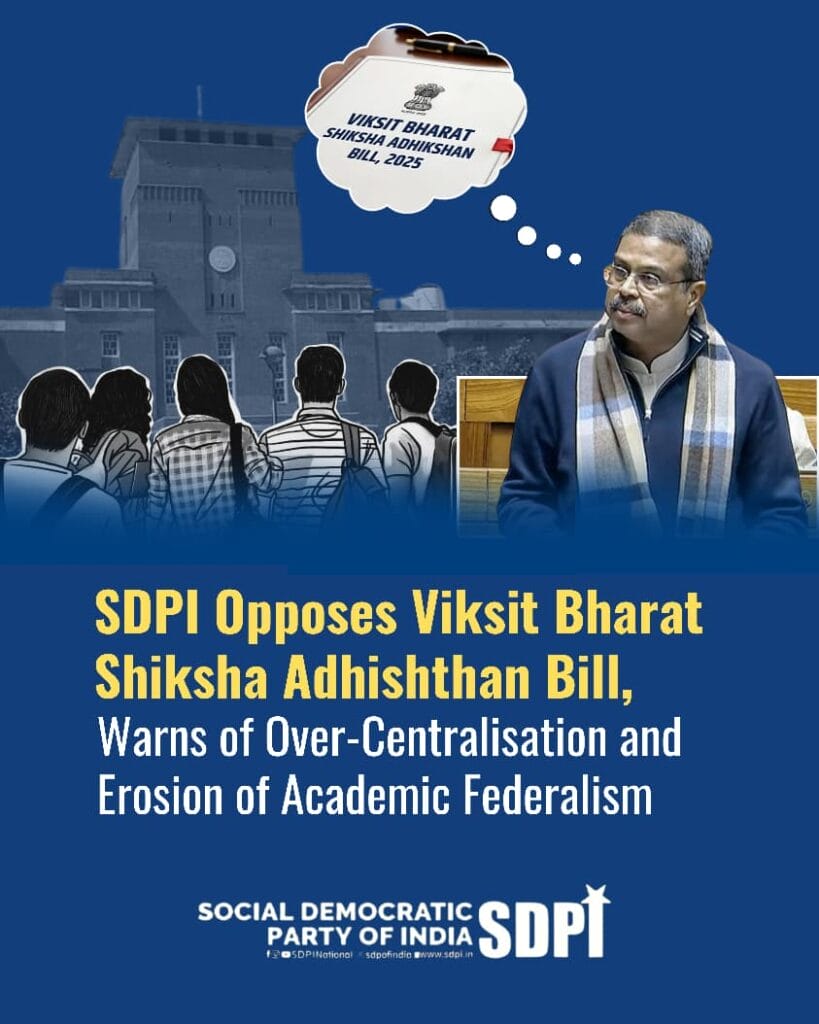
The Social Democratic Party of India (SDPI) has strongly opposed the Viksit Bharat Shiksha Adhishthan Bill, 2025, introduced in the Lok Sabha by Union Education Minister Dharmendra Pradhan, terming it a dangerous centralisation of power that threatens academic freedom, federal balance and social inclusion in higher education.
In a statement issued on Monday, SDPI said that while the Union government is projecting the Bill as a reform aligned with the National Education Policy (NEP) 2020, its actual architecture concentrates unprecedented authority in a single, centrally controlled apex body, effectively dismantling long-standing statutory safeguards that have governed higher education for decades.
Abolition of Statutory Bodies Raises Alarm
The Bill proposes to repeal the University Grants Commission (UGC) Act, 1956, the All India Council for Technical Education (AICTE) Act, 1987, and the National Council for Teacher Education (NCTE) Act, 1993, subsuming all three under the proposed Viksit Bharat Shiksha Adhishthan. SDPI warned that abolishing these statutory regulators without robust parliamentary oversight mechanisms weakens institutional checks and balances painstakingly built over the years.
“Replacing multiple statutory bodies with one super-regulator does not simplify governance—it silences dissent, marginalises states, and centralises academic control in New Delhi,” said Mohammed Shafi, national vice president, SDPI.
Assault on Federalism and States’ Rights
Invoking Entry 66 of the Union List to justify the Bill, SDPI argued that the Centre is stretching constitutional interpretation to encroach upon domains where states have historically exercised autonomy, particularly in public universities and teacher education.
“Higher education is not merely about ‘standards’; it is also about social context, language, access and regional equity. This Bill risks imposing uniformity at the cost of India’s academic diversity,” the statement noted.
‘Faceless Regulation’ May Mean Unaccountable Regulation
The government’s promise of a technology-driven, faceless single-window regulatory system was described by SDPI as “opaque governance masked as transparency.”
“Faceless systems may reduce human interface, but they also reduce accountability. Students, teachers and smaller institutions—especially in rural and marginalised regions—will struggle to challenge arbitrary decisions taken through digital portals,” SDPI cautioned.
Autonomy for a Few, Insecurity for Many
SDPI further criticised the Bill’s emphasis on enhanced autonomy for so-called ‘high-performing’ higher educational institutions, warning that it would deepen inequality across the sector.
“Elite institutions will flourish, while public universities serving first-generation learners, minorities, Dalits and Adivasis may be pushed into chronic underfunding and stricter surveillance,” the party said.
Student-Centric Claims Questioned
While the Bill claims to be student-centric, SDPI pointed out that students’ representation in governance remains minimal, and grievance-redressal mechanisms are housed within the same regulatory structure—raising serious concerns of conflict of interest.
“True student empowerment comes from democratic participation, not feedback forms on digital dashboards,” SDPI asserted.
Part of a Larger Centralising Agenda
The party linked the Bill to what it described as a broader pattern under the BJP-led government headed by Narendra Modi, accusing it of systematically weakening autonomous institutions, including universities and constitutional bodies.
SDPI’s Demands
SDPI demanded that:
The Bill be withdrawn and referred to a Parliamentary Standing Committee
States, teachers’ unions, students’ organisations and minority institutions be meaningfully consulted
Existing statutory bodies be reformed, not abolished
Federal principles and social justice mandates be explicitly safeguarded in law
“India does not need a corporatised, centralised education model. It needs a democratic, inclusive and federal higher education system that treats education as a public good—not a regulatory experiment,” the statement concluded.
SDPI Media Cell

No Comments