
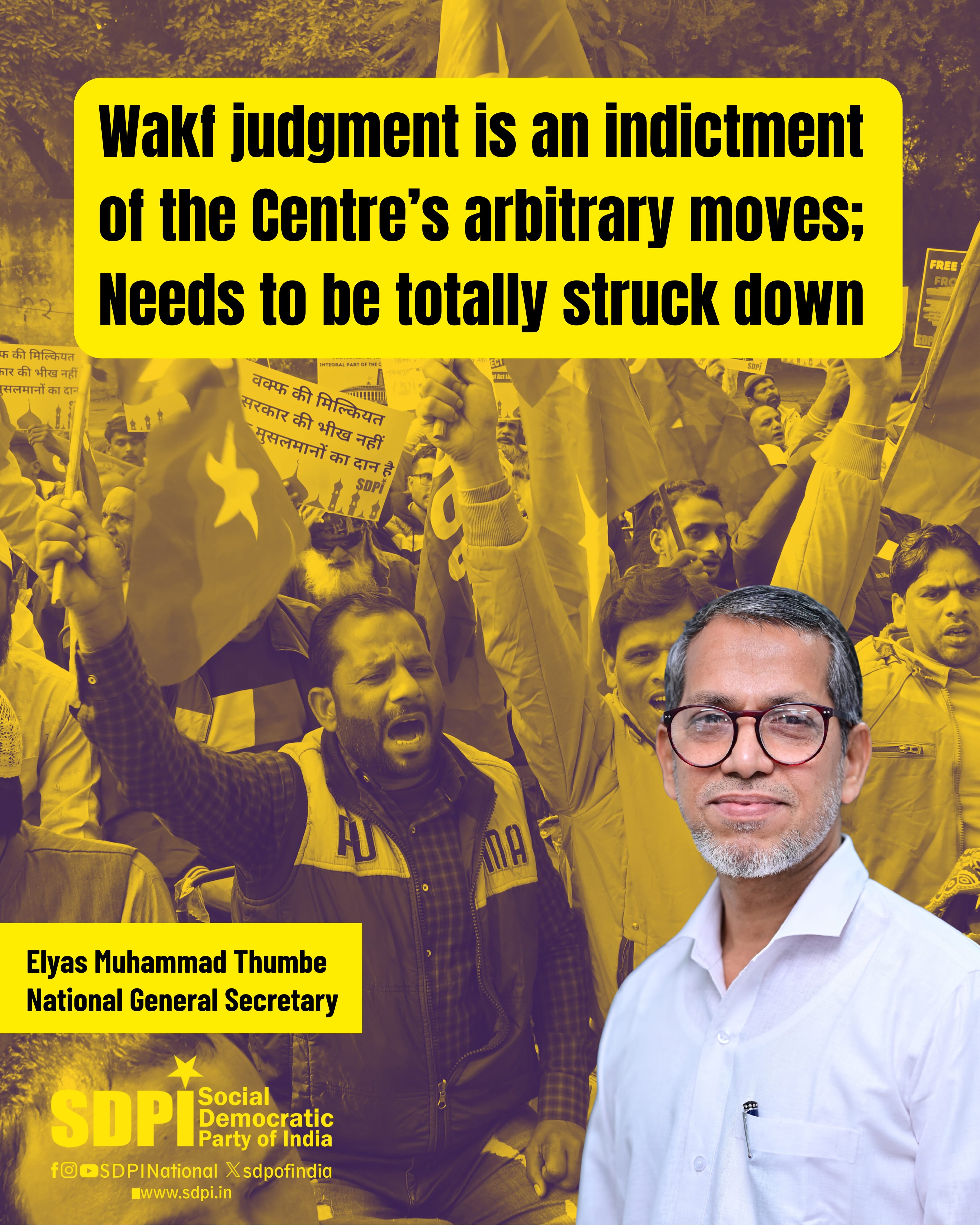
Wakf judgment is an indictment of the Centre’s arbitrary moves;
Needs to be totally struck down
The judgment delivered by the Supreme Court in the litigation challenging the Wakf (Amendment) Act 2025, is a scathing indictment of the Central Government’s arbitrary moves to deny even the basic minimum of legal protection to the Muslim community in managing their vital affairs and interests.
Coming after a series of actions of a similar nature including the Citizenship Amendment Act, the efforts to impose a National Register of Citizens which could deny a large number of Muslims their citizenship rights, the Special Intensive Revision of the voters list that could disenfranchise substantial sections of Muslims as aliens and unlawful immigrants, the Wakf Amendment Act was seen as another move to disempower the community and divert it of properties they held and enjoyed for hundreds of years. Many of the provisions in the Wakf Act were seen and criticised as arbitrary and against the interests of the community. Many legal experts and community leaders had raised these legitimate concerns right from the moment the Bill was introduced by the Home Minister in Parliament, and later when it went to the consideration of a Joint Parliamentary Committee, which often refused to discuss or try to find solutions to these concerns. Instead the JPC chairman, Mr Jagadambika Pal who is a senior BJP leader, was seen acting as a spokesperson for the Home Ministry and the right-wing Hindutva forces who were making every efforts to destroy the Muslim community and their economic, social and cultural assets. They made the wakf reforms also as another tool to enforce their divisive agenda.
It is in these circumstances the Supreme Court intervention staying some of the most vicious provisions in the Act, comes as a great relief to the community. The judgement delivered by Chief Justice B R Gavai and Justice A G Masih, has pointed out that some of the provisions are “prima facie arbitrary” and stuck down such provisions like the sub section 2 of Sec. 3C and Sec. 3C(3) and Sec. 3C(4) of the Act. These provisions had empowered the authorities to divest wakf properties of their status the moment someone alleges the said property as encroachment of government lands giving no prior notice or an opportunity to the affected parties to an impartial hearing; providing opportunity to Government officials to indefinitely delay proceedings affecting the survival of institutions and others dependent on these properties; vesting powers on government officials to change the Revenue records altering the status of wakf properties unilaterally, etc. These are absolutely unjust and arbitrary provisions which the court has found unacceptable.
But despite such massive infirmities in the legislation, the court has refused to totally and unambiguously strike it down by way of a total stay to its operation. This is really unfortunate. The court appears to have made an effort to strike a balance, allowing the Act to remain in statutes and accepting many other provisions in the Act including registration process for wakf properties. The court’s justification seems to be the need for reforms in Wakf Act and the need for proper administration of these properties spread all over the country.
There is no denial that wakf properties need to be properly and efficiently administered and the widespread corruption weeded out. In fact, the Muslim community leaders and their organisations have pointed out the need for reforms and efficiency in their administration to remove the anomalies. But to do so, a sincere and just approach is absolutely necessary. The BJP Government and its Home Ministry have exposed themselves in their ulterior and mischievous motives while steamrollering through this piece of legislation making use of their numerical majority in Parliament. But the legislation has never had any legitimacy as it was imposed on the Muslim properties without any consent from the community. Hence it would have been much better for the Supreme Court to strike it down lock stock and barrel and pave the way for a more nuanced, consensual legislation to bring about reforms in wakf administration.
Elyas Muhammed Thumbe
National General Secretary
Social Democratic Party of India

No Comments