
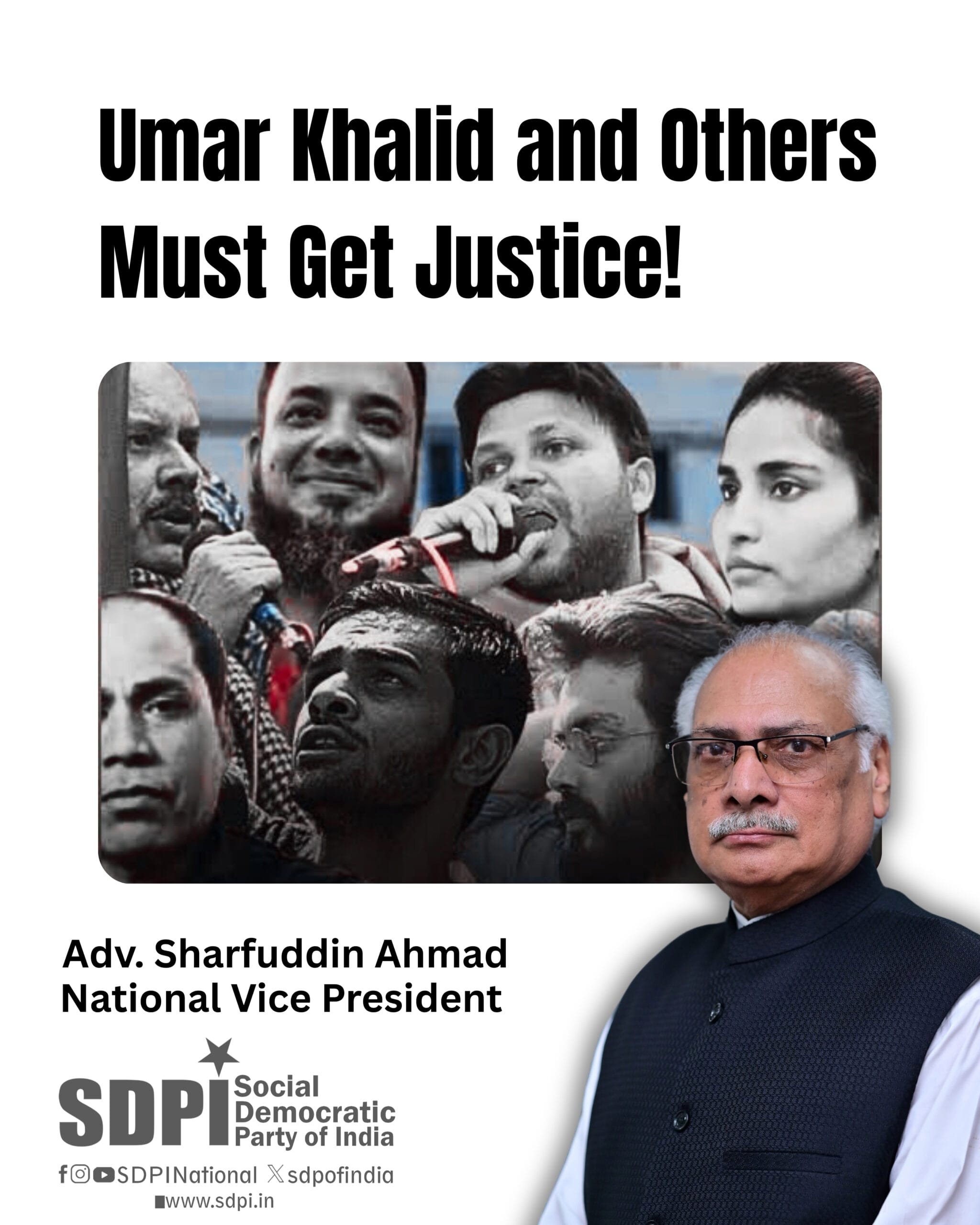
Umar Khalid and Others Must Get Justice!
Adv. Sharfuddin Ahmad
National Vice President
Social Democratic Party of India
The order of the Delhi High Court, rejecting bail to the ten accused in the 2020 Delhi riots case is absolutely unfortunate and, considering the terrible delays and the prejudiced manner in which the Delhi police and the prosecution conducted the proceedings, a travesty of justice. Brilliant youngsters who are the cream of our society have been languishing in jail for five years and the trial looks unlikely to begin anytime soon and still the court found it convenient to keep them under incarceration. This goes against the fundamental norms of justice where bail is deemed the rule and jail an exception.
Among those who were denied bail are JNU students Sharjeel Imam and Umar Khalid, known for their academic brilliance and dedication to social causes, but unfortunately none of these facts seem to have been considered by the court while coming to its conclusion. The court, while accepting the rights of citizens to hold peaceful protests, has said that such protections could not be extended to “conspiratorial violence.”
It is surprising that the judges came to such a conclusion even as the trial is yet to begin. The police investigations and prosecution procedures have continued for five years and there is no justifiable reason why they should still be denied bail. But the Solicitor General who appeared for the Government opposed the bail application. He claimed that it was a well orchestrated conspiracy aimed at thwarting the visit of the US President to India. The court appears to have accepted this view without any questions.
The facts of the case, however, present a different picture. At the time of the massive protests against the Government moves to impose the CAA and NRC, large numbers of people had come out into the streets all over the country, to raise their voices against these nefarious moves which they apprehended would deny citizenship rights to many Indian people. These protests were peaceful and people from every section of Indian society, including members of all communities and large numbers of women, had taken part in these protests. It was a magnificent display of unity of Indian people cutting across the differences of caste, community, region and language.
It was at this point that some incidents of communal violence were engineered in some parts of Delhi. Who were behind these sudden incidents of violence is a matter for the judiciary to identify, but the circumstances of these developments point to the involvement of the agencies of the “deep state”, who were terrified by the emerging national unity against the ill-advised moves to implement the CAA and NRC. The public protests were a direct challenge to the divisive agenda of the Sangh Parivar who were taking control of the administration to enforce the Hindutva agenda where minorities, especially Muslims, were a prime target. So they wished to destroy the spirt of unity among the protestors.
The incendiary speeches made by Union Minister Anurag Thakur and other Sangh Parivar activists are still in public memory. They wanted the protesters to be dealt with bullets. It was at this time the incidents of violence started. Some of the Malayalam channels like Asianet and Media One who exposed the real nature of the communal violence in which mostly Muslims were the victims, faced unprecedented actions from the Central Government in retaliation for their objective reporting from the field. Both channels were disallowed broadcasting rights, though actions against the Asianet –owned by a BJP bigwig- were withdrawn while the Media One, run by a Jamaat-e-Islami trust, had to go to the Supreme Court to fight for restoring its rights to function as an independent media entity.
So the denial of bail to these young activists even after five years of incarceration is a matter of shame to the country, as they were upholding the rights of the citizens to protest against the actions of an unruly executive, bent upon dividing the country on communal lines. The judiciary must ensure that justice prevails and they should also remember that justice delayed is justice denied.

No Comments