
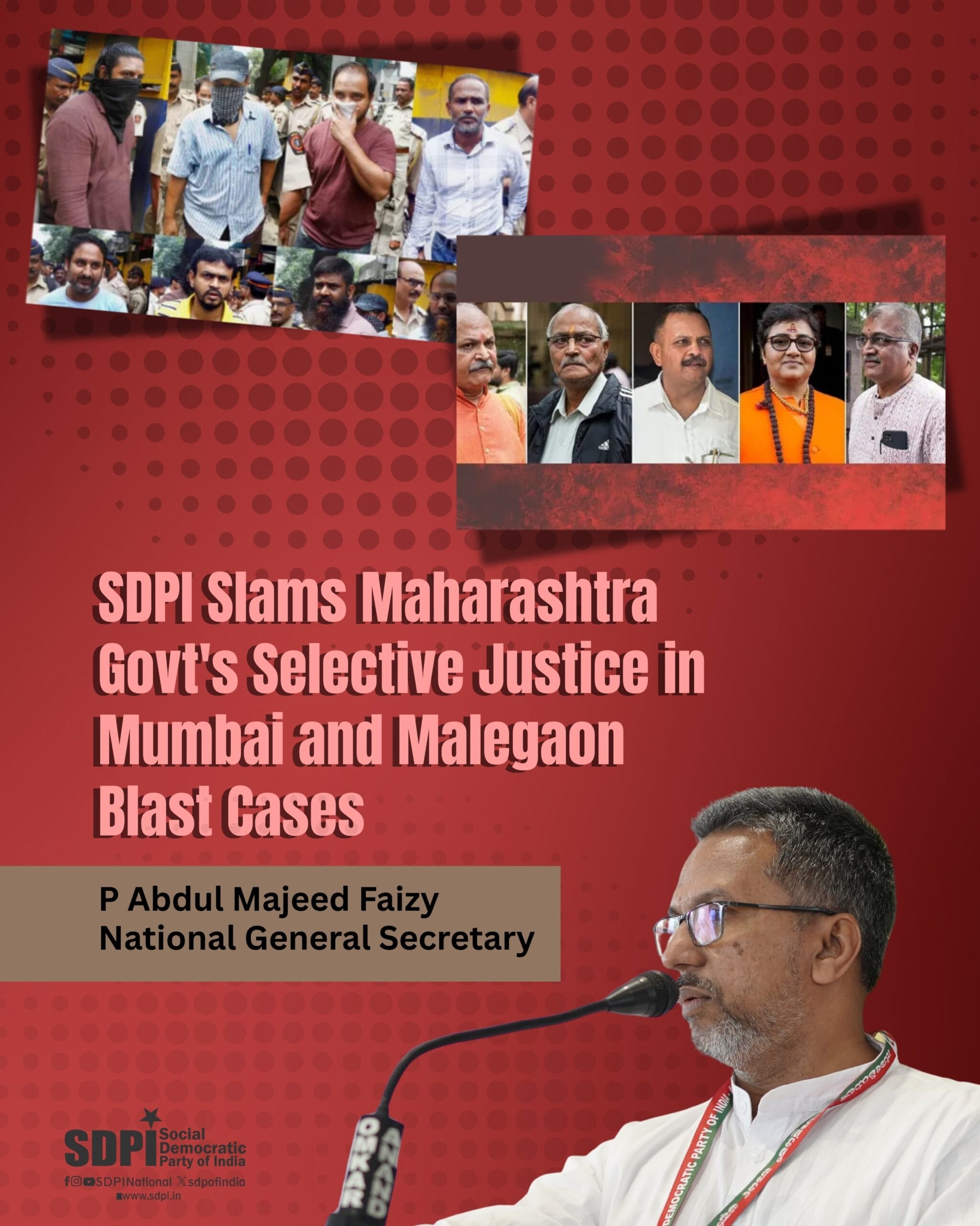
SDPI Slams Maharashtra Government’s Selective Justice in Mumbai and Malegaon Blast Cases
P Abdul Majeed Faizy, National General Secretary of the Social Democratic Party of India strongly condemns the maharashtra government’s discriminatory approach in addressing the acquittals in the 2006 mumbai train blasts and 2008 malegaon bomb blast cases. The stark contrast in the state’s response to these verdicts raises serious questions about its commitment to impartial justice and exposes a troubling bias that undermines the rule of law.
On july 21, 2025, the bombay high court acquitted 12 accused in the 2006 mumbai train blasts case, which claimed 189 lives and injured over 800. The court cited procedural lapses, unreliable witness testimonies, and improper invocation of mcoca. Chief minister devendra fadnavis, without reviewing the full judgment, promptly announced an appeal to the supreme court, which stayed the verdict within days. This swift action reflects the government’s urgency to address perceived injustice for victims of the mumbai blasts, where all accused were muslim.
In contrast, the maharashtra government has chosen not to appeal the july 31, 2025, acquittal of seven accused, including pragya singh thakur and lt. Col. Prasad purohit, in the 2008 malegaon blast case, as revealed by an rti query. This blast, killing six and injuring nearly 100 in a muslim-majority area, saw the NIA court cite a lack of “reliable and cogent” evidence, pointing to the investigating agency’s failure to substantiate claims of a conspiracy by the extremist group abhinav bharat. The court explicitly criticized the NIA’s handling, noting issues like hostile witnesses and unproven links to the accused. Yet, the government’s silence on appealing this verdict, despite a three-month window, starkly contrasts with its proactive stance in the mumbai case.
The merit of both cases reveals glaring inconsistencies. In the mumbai train blasts, the court emphasized the injustice to victims due to procedural errors, yet the government prioritized an appeal to restore accountability. In malegaon, the court’s critique of the nia’s “game” of weak evidence and failure to pursue perjury charges against 34 hostile witnesses underscores investigative lapses, yet the government’s inaction suggests selective outrage. This discrepancy, especially given the political affiliations of the malegaon accused, fuels allegations of bias favoring Extremist groups over muslim communities.
The sdpi demands that the maharashtra government appeal the malegaon verdict to ensure justice for victims and address the NIA’s failures. We call for an independent inquiry into the state’s inconsistent approach to terror cases. Justice must be blind to religion and politics, and the sdpi stands with the victims of both tragedies in their pursuit of truth and accountability.

No Comments