
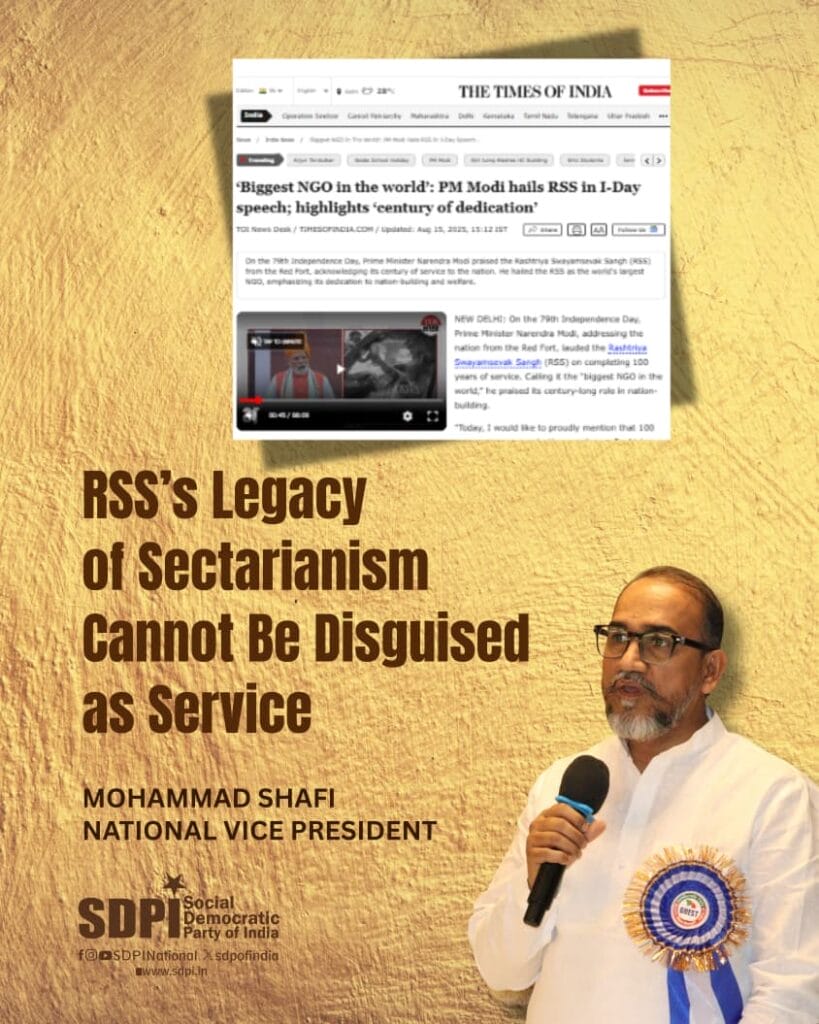
RSS’s Legacy of Sectarianism Cannot Be Disguised as Service
Mohammad Shafi, National Vice President of the Social Democratic Party of India, strongly condemns the misleading claims made by Prime Minister Narendra Modi in his Independence Day address. In his speech, Modi described the RSS as the “biggest NGO in the world” and praised its “century of dedication.” These assertions, politically expedient for the BJP and its ideological parent, are factually baseless and stand in direct contradiction to historical evidence and multiple judicial inquiries.
The SDPI rejects the notion that the RSS qualifies as an NGO. In India, NGOs are legally registered entities, accountable to the Societies Registration Act of 1860 or equivalent laws, and bound by audit and transparency norms. The RSS, founded in 1925 as a volunteer paramilitary force rooted in Hindutva ideology, has no such registration. Its claims of thousands of shakhas and social projects are neither audited nor independently verified. To describe it as the “largest NGO” is a deliberate exaggeration meant to cloak a sectarian movement in moral legitimacy.
Historical records expose the RSS’s absence from the freedom struggle. British archives confirm that the RSS deliberately stayed aloof from the Quit India Movement of 1942 and instructed its cadres not to provoke the colonial state. While leaders such as Gandhi and Nehru were imprisoned, the RSS prioritised building a Hindu cadre. Scholars have documented that M.S. Golwalkar and other Hindutva leaders admired authoritarian European regimes of the 1930s. Meanwhile, V.D. Savarkar openly supported the British war effort during World War II. This ideological and strategic choice to collaborate rather than resist betrays the sacrifices of millions who fought for independence.
The RSS’s post-independence record is equally troubling. It was banned in 1948 after Mahatma Gandhi’s assassination by Nathuram Godse, a man steeped in Hindutva ideology. It was banned again during the Emergency of 1975 and in 1992 following the demolition of the Babri Masjid. The Liberhan Commission categorically held the RSS, along with the VHP, Bajrang Dal, and senior BJP leaders, responsible for orchestrating the Babri demolition. The Srikrishna Commission revealed the role of Sangh-linked groups in the Mumbai riots of 1992–93, while the Justice Reddy Commission documented RSS and Jana Sangh involvement in the 1969 Ahmedabad violence. These reports together expose a pattern of sectarian mobilisation under the guise of cultural service.
The SDPI affirms that the Prime Minister’s glorification of the RSS is not an act of statesmanship but of distortion. By equating divisive mobilisation with genuine social service, Modi dishonours India’s freedom fighters and undermines constitutional values of justice, equality, and fraternity.
The SDPI calls upon democratic forces, civil society, and citizens committed to secularism to confront these misrepresentations and uphold the inclusive legacy of India’s freedom struggle.

No Comments