
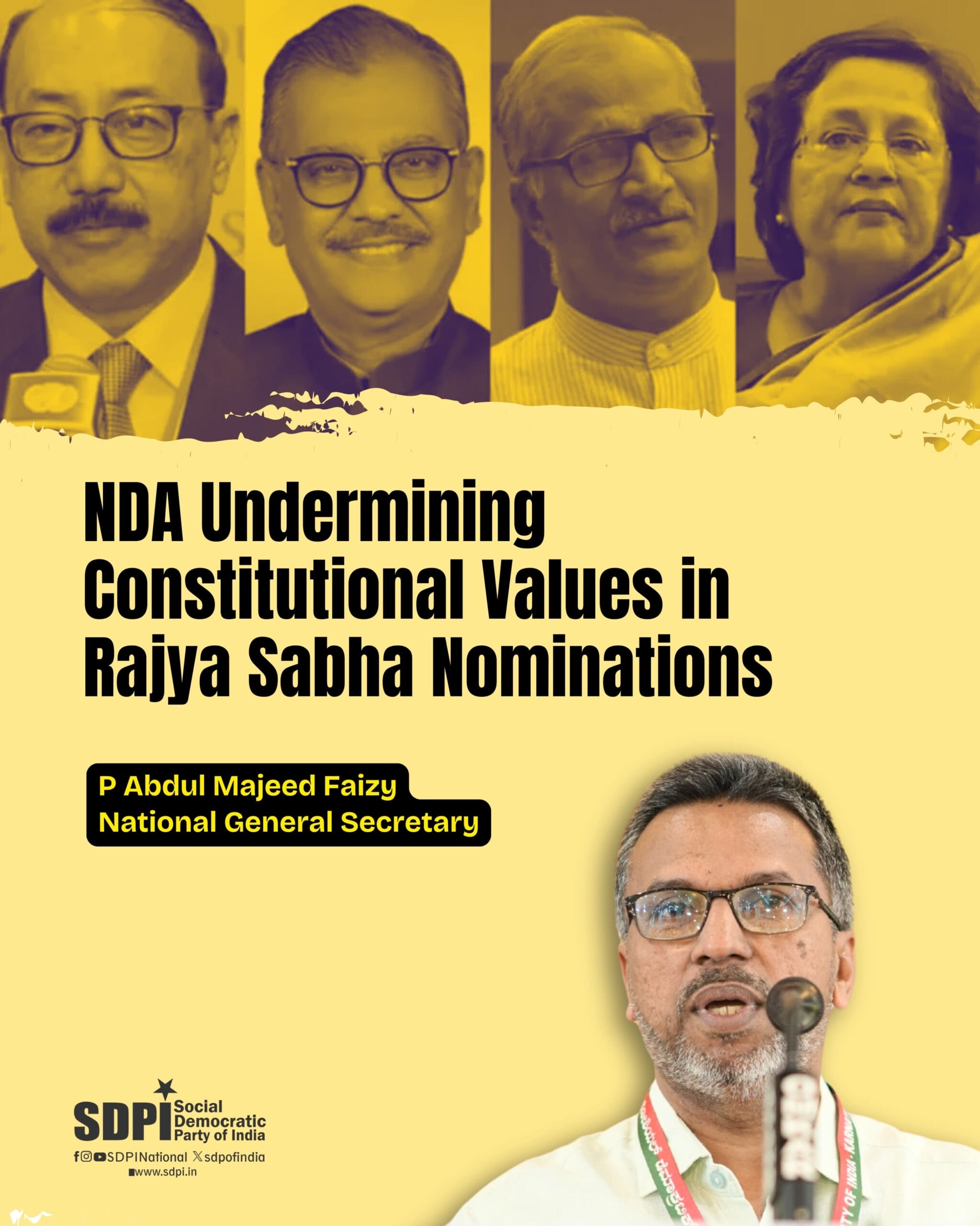
NDA Undermining Constitutional Values in Rajya Sabha Nominations: P Abdul Majeed Faizy
P Abdul Majeed Faizy, National General Secretary of the Social Democratic Party of India, challenged the nominations of Ujjwal Nikam, Harsh Vardhan Shringla, C. Sadanandan Master, and Meenakshi Jain for their to the Rajya Sabha by President Droupadi Murmu. Although they meet the basic eligibility under Article 84, their selection under Article 80(3) favors political affiliations with the Bharatiya Janata Party or its ideological parent, the Rashtriya Swayamsevak Sangh, over impartial expertise in fields like literature, science, art, or social service, raising serious concerns about the transparency and fairness of the process.
Ujjwal Nikam’s nomination raises serious doubts due to actions undermining his suitability for a Rajya Sabha role requiring impartial expertise. During the 26/11 Mumbai terror trial, he admitted fabricating a claim that the accused demanded biryani, a move to inflame public sentiment that compromised judicial integrity. His frequent media appearances in high-profile cases, like the 1993 Mumbai blasts, suggest a focus on publicity over judicial restraint. Moreover, Nikam’s recent BJP affiliation and his unsuccessful 2024 Lok Sabha candidacy from Mumbai North Central indicate his nomination rewards political loyalty rather than independent legal expertise. His appointment as special public prosecutor in the 2024 Badlapur sexual assault case, despite objections over his BJP ties, further highlights concerns about his impartiality.
Harsh Vardhan Shringla, a retired diplomat and former Foreign Secretary, joined the BJP after his tenure, aligning with the ruling party’s ideology. His nomination reflects the NDA’s tendency to favor political loyalists over independent experts, contrary to the constitutional requirement for non-partisan contributions in fields like social service. This alignment casts doubt on his ability to offer unbiased perspectives in the Rajya Sabha, especially given his lack of notable post-retirement contributions to public service outside party activities.
C. Sadanandan Master’s nomination is deeply concerning due to his leadership as a former district sahakaryavahak and boudhik pramukh in the RSS in Kannur, a region marked by political murders during his tenure. His RSS affiliation promotes a divisive narrative aimed at strengthening electoral support in Kerala, rather than demonstrating eminence in social service. His role as president of the RSS-affiliated National Teachers’ Union appears to be the primary basis for his nomination, raising questions about its alignment with the constitutional criteria for impartial expertise.
Meenakshi Jain’s historical scholarship, particularly her book Sati, has been criticized for selectively downplaying documented practices to align with the BJP’s Hindu nationalist agenda. Her work on the Ayodhya dispute and Hindu temple traditions raises concerns that her nomination seeks to promote a divisive cultural narrative in education and policy, rather than fostering pluralistic discourse. As the only woman nominee, her selection does not adequately represent broader gender or community diversity in the Rajya Sabha.
The BJP-led NDA’s non-transparent nomination process, conducted without public consultation, excludes marginalized communities and fields like science and literature, favoring political patronage over impartial expertise. The SDPI demands a transparent, inclusive process that upholds the constitutional mandate by prioritizing diverse, independent experts.

No Comments