
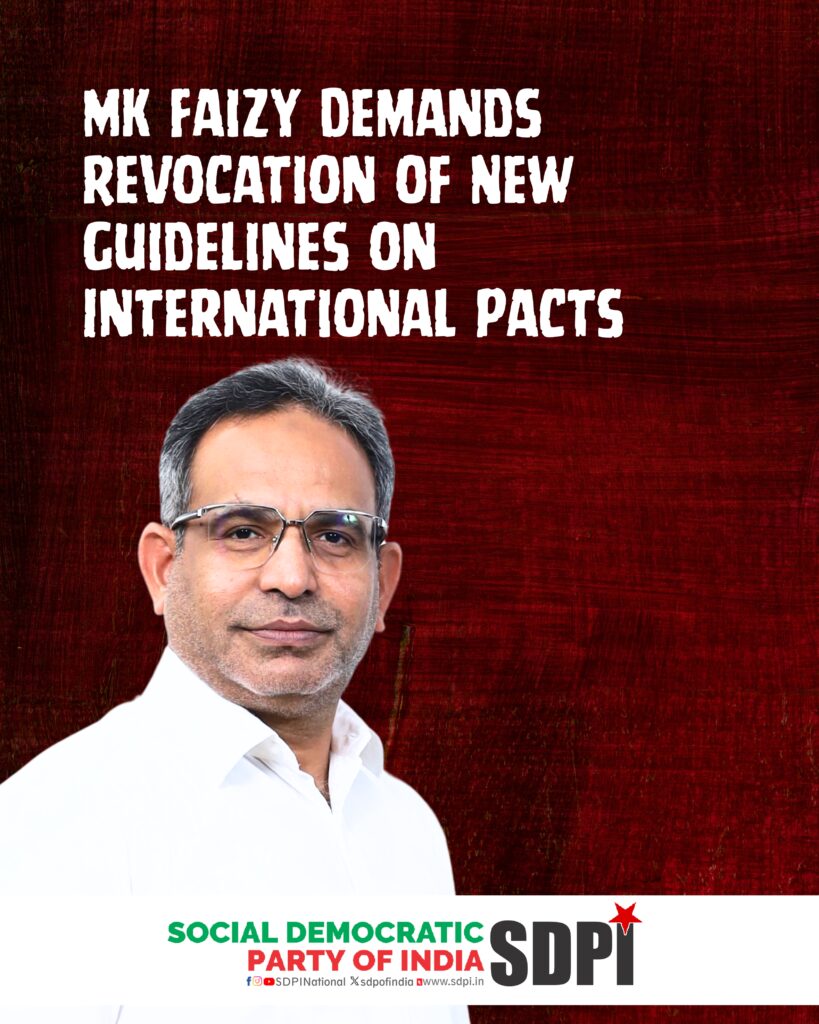
MK Faizy Demands Revocation of New Guidelines on International Pacts
MK Faizy, National President of the Social Democratic Party of India, has demanded the immediate revocation of the Union government’s recent administrative decision removing the requirement of prior Cabinet approval for certain international instruments signed during the Prime Minister’s overseas visits or during visits by foreign leaders to India. The directive, reportedly issued by the Cabinet Secretariat on February 18 without public announcement or parliamentary discussion, has raised serious concerns about transparency and democratic accountability in the conduct of India’s foreign policy.
Under the revised guidelines, several categories of international instruments, including memoranda of understanding and joint declarations of intent, may now be concluded without prior consideration by the Union Cabinet. Instead, such documents can proceed after clearance from the Legal and Treaties Division of the Ministry of External Affairs, provided they carry no explicit financial commitments and avoid formal treaty terminology such as treaty, convention, or agreement. These instruments may be signed during high level diplomatic engagements, with the Cabinet receiving only periodic reports for information rather than deliberation or approval. Faizy warned that this change weakens the principle of collective responsibility that underpins the Cabinet system and is reflected in the Transaction of Business Rules of 1961.
The party also questioned the intent behind introducing such a significant procedural change without public discussion or parliamentary scrutiny. Faizy said the move raises concerns about whether certain international understandings are being kept beyond broader governmental oversight, including scrutiny by members of the Cabinet. He cautioned that weakening established checks could allow decisions that escape democratic accountability. At a time when the government faces criticism over policies perceived to favour large corporate interests, such exemptions risk deepening public suspicion about whose interests these arrangements ultimately serve. He stressed that international engagements must remain transparent, accountable, and guided solely by the national interest rather than the priorities of select corporate groups.

No Comments