
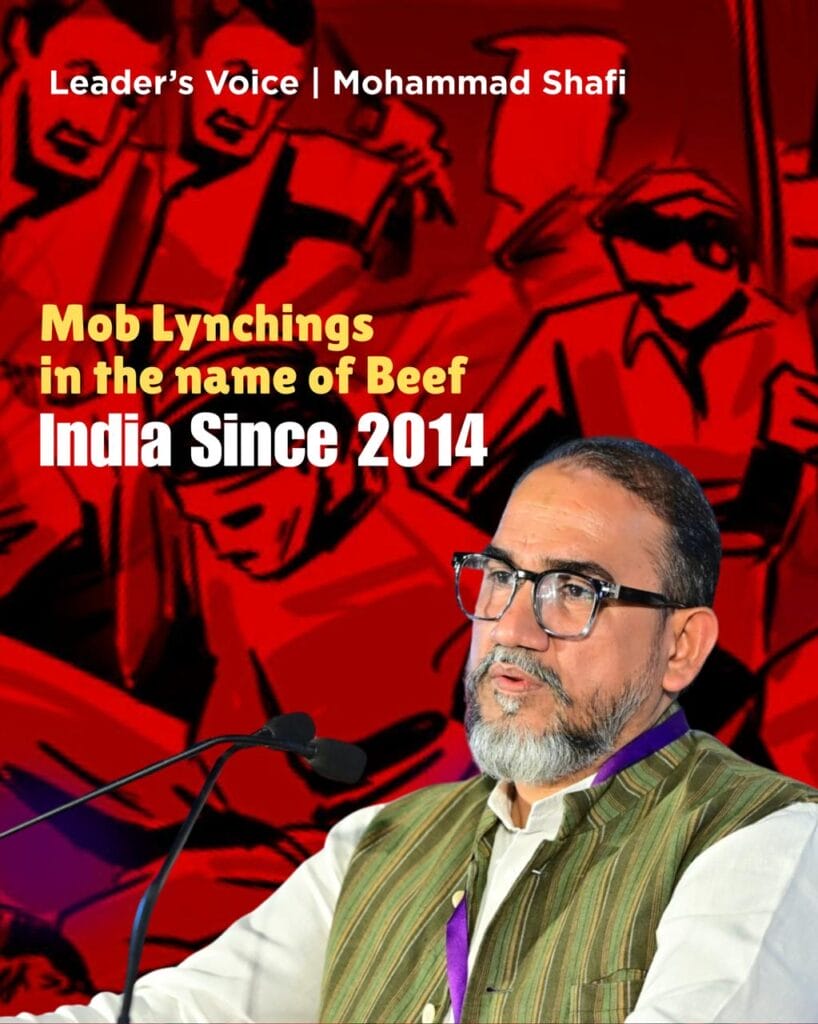
Leader’s Voice | Mohammad Shafi
Mob Lynchings in the name of Beef: India Since 2014
The Aligarh and Vijay Nagar Lynchings
In late May 2025, two shocking incidents in Aligarh, Uttar Pradesh, and Vijay Nagar, Delhi, underscored India’s ongoing struggle with mob violence fueled by baseless allegations of beef possession. On May 24, 2025, in Aligarh, four Muslim men—Arbaz, Aqeel, Kadim, and Munna Khan—were viciously attacked by a mob of cow vigilantes over claims of smuggling beef. The assailants, linked to Hindu right-wing groups, set the victims’ vehicle ablaze, blocked a highway, and assaulted the men with sharp weapons, bricks, and sticks. Disturbing footage showed one unconscious victim being dragged from a police vehicle. This marked the second attack on the same group at the same location within 15 days, suggesting targeted violence. A forensic report from a government laboratory in Mathura later confirmed the meat was not beef, debunking the allegations. Police arrested four individuals, charging them under the Bhartiya Nyaya Sanhita for rioting, attempt to murder, extortion, and dacoity. Just four days later, on May 28, 2025, in Vijay Nagar near Delhi University’s North Campus, Chaman Kumar, a 44-year-old grocery shop owner, was assaulted by a mob over allegations of selling cow meat, prompted by a 15-year-old boy’s complaint that he purchased meat for Rs 400 per kg. Police seized meat samples for forensic testing, provided medical assistance to Kumar, and are investigating, with no confirmation of beef as of May 29, 2025. These incidents highlight a chilling trend: unverified accusations driving communal violence.
The Rise of Mob Lynchings Post-2014
Since Narendra Modi’s swearing-in as Prime Minister on May 26, 2014, India has seen a surge in mob lynchings, often perpetrated by Hindu right-wing vigilante groups targeting Muslims and Dalits over unverified claims of cow slaughter or beef possession. Despite forensic evidence frequently disproving these allegations, perpetrators often face little accountability, emboldened by perceived support from government, police, and BJP-affiliated groups. This article examines this trend, its communal roots, and its threat to India’s secular democratic fabric.
The reverence for cows in Hinduism, coupled with stringent cow protection laws in states like Uttar Pradesh, Haryana, and Rajasthan, has created a fertile ground for vigilante violence. Since 2014, the rise of Hindu nationalist rhetoric under the BJP-led government has coincided with increased lynchings, particularly targeting Muslims and Dalits in the cattle trade or meat industry. A 2019 report documented 44 cow-related lynchings between 2015 and 2018, with 36 Muslim victims, noting that 97% of such incidents occurred after Modi’s ascent. The following timeline highlights key cases where beef allegations were debunked or unverified, illustrating a pattern of baseless violence driven by communal prejudice.
Timeline of Notable Lynchings
September 2015 – Dadri, Uttar Pradesh: Mohammad Akhlaq, a 50-year-old Muslim and father of a soldier, was lynched in Bisada village over rumors of storing beef. A mob, incited by a temple announcement, beat him to death and injured his son. Forensic tests initially confirmed the meat was mutton, not beef, though political pressure led to conflicting reports. The mob didn’t wait for proof; they acted on suspicion alone. Despite arrests, several accused were granted bail, and the case remains unresolved, reflecting judicial delays.
March 2016 – Latehar, Jharkhand: Mazlum Ansari and Imteyaz Khan, Muslim cattle traders, were lynched and hanged in Latehar. No evidence of cow slaughter was found; the attack was linked to extortion rackets. Eight perpetrators were convicted in 2018, a rare instance of justice.
April 2017 – Alwar, Rajasthan: Pehlu Khan, a Muslim dairy farmer, was killed while legally transporting cows. No beef was involved, yet attackers faced no immediate consequences. “The police watched as I begged for my father’s life,” Khan’s son testified. The 2019 acquittal of six accused sparked outrage, with the case under appeal.
June 2018 – Hapur, Uttar Pradesh: Qasim, a Muslim cattle trader, was lynched over cow slaughter rumors. No beef evidence was found. The Supreme Court ordered a reinvestigation, but justice remains elusive.
July 2018 – Alwar, Rajasthan: Rakbar Khan was lynched while transporting cows. Police delays in providing medical aid contributed to his death. No beef smuggling was confirmed. “The police took him to tea, not the hospital,” Khan’s family alleged. Arrests were made, but convictions are pending.
May 2019 – Seoni, Madhya Pradesh: Two Muslim men were beaten over suspected beef possession. Forensic tests confirmed the meat was mutton. “False accusations are a weapon against us,” a victim’s relative said. Arrests followed, but the case languishes in court.
February 2023 – Bhiwani, Haryana: Junaid and Nasir were burned to death in a car by cow vigilantes. No beef evidence was found. The killers boasted of their act, knowing they’d face no consequences.. Arrests occurred, with allegations of police complicity ongoing.
August 2024 – Charkhi Dadri, Haryana: Aryan Mishra, a 19-year-old Hindu student, was shot dead by vigilantes mistaking him for a Muslim smuggler. No cow smuggling was confirmed. Even Hindus aren’t safe from this madness. Five arrests were made.
September 2024 – Faridabad, Haryana: Sabir Malik, a Muslim ragpicker, was lynched over beef consumption rumors. Preliminary reports found no beef. The mob didn’t care about truth; they saw a Muslim and attacked. Four arrests were made, with investigations ongoing.
May 24, 2025 – Aligarh, Uttar Pradesh: As detailed, the second attack within 15 days highlights targeted violence. The forensic report confirmed no beef, yet the mob acted with impunity.
May 28, 2025 – Vijay Nagar, Delhi: Chaman Kumar, a 44-year-old grocery shop owner, was assaulted by a mob near Delhi University’s North Campus over allegations of selling cow meat.
Debunked Allegations
The absence of evidence supporting beef-related allegations is a recurring theme. Forensic reports from government laboratories, as in Dadri (2015), Seoni (2019), and Aligarh (2025), consistently debunked claims of cow slaughter or beef possession. In Vijay Nagar (2025), forensic results are pending, but the pattern of unverified accusations persists. Vigilante groups, fueled by rumors on social media or local networks like WhatsApp and temple announcements, bypass legal processes, acting as judge and executioner. Forensic truth comes too late for the victims. Rapid forensic testing could counter misinformation, but its impact is limited when perpetrators face minimal accountability, as seen in the judicial delays in Dadri and Alwar.
Government, Police, and BJP: Enabling Impunity
The BJP-led government’s stance on cow vigilantism has been mixed. In 2016, Prime Minister Modi condemned such violence, stating, “Killing in the name of cow protection is unacceptable.” However, inflammatory remarks by BJP leaders have often fueled vigilante actions. In April 2017, Rajasthan BJP lawmaker Gyan Dev Ahuja justified Pehlu Khan’s lynching, saying, “We have no regret over his death because those who are cow smugglers are cow-killers; sinners like them have met this fate earlier and will continue to do so.” Similarly, in October 2015, Haryana Chief Minister Manohar Lal Khattar stated, “Muslims can continue to live in this country, but they will have to give up eating beef. The cow is an article of faith here.” In November 2017, Uttar Pradesh Chief Minister Adityanath declared, “There is only one way to protect Indian culture: to protect gau (cows), Ganga, and (goddess) Gayatri… Only the community that can protect this heritage will survive.” Other BJP leaders, such as Telangana’s T Raja Singh Lodh in July 2018, vowed, “Till cow is not accorded the status of ‘Rashtra Mata’ [Mother of the Nation], I feel the war for gau raksha will not stop even if gau rakshaks are put into jails or bullets are fired at them.” In May 2015, BJP Union Minister Mukhtar Abbas Naqvi remarked, “Those who are dying without eating beef, can go to Pakistan or Arab countries or any other part of world where it is available.” Following Mohammad Akhlaq’s lynching, BJP MP Sakshi Maharaj said in October 2015, “We won’t remain silent if somebody tries to kill our mother. We are ready to kill and be killed.” In April 2017, Chhattisgarh Chief Minister Raman Singh stated, “We will hang those who kill cows,” and in March 2017, Uttar Pradesh BJP lawmaker Vikram Saini added, “I had promised that I will break the hands and legs of those who do not consider cows their mother and kill them.” These statements, coupled with strengthened cow protection laws, like Uttar Pradesh’s 2020 amendment imposing harsh penalties for slaughter, create a framework that vigilantes exploit.
Police responses vary, often raising concerns of complicity or negligence. In Alwar (2018), Rakbar Khan died partly due to police delays, with officers reportedly stopping for tea en route to the hospital. In Bhiwani (2023), allegations surfaced that police shared information with vigilantes, facilitating the attack. The police often side with the mob, either out of fear or bias. A 2023 report noted that 70% of cow vigilante violence occurs in BJP-ruled states, suggesting a correlation between political rhetoric and mob actions. The government’s silence after lynchings sends a message: vigilantes are above the law. Judicial delays, with cases like Dadri and Alwar languishing for years and accused often securing bail, exacerbate impunity.
The Communal Atmosphere and Erosion of Secular Democracy
India’s Constitution enshrines secularism and equality, yet the rise of Hindu nationalism since 2014 has strained this ethos. Mob lynchings, driven by communal prejudice, reflect a shift toward majoritarianism. Muslims and Dalits, who dominate the cattle and meat trades, are disproportionately targeted, with vigilantes exploiting religious sentiments to justify violence. “This is not about cows; it’s about asserting Hindu dominance,” a sociologist observed. Social media, including WhatsApp groups and local announcements, amplifies rumors, as seen in Dadri and Hapur, inciting mobs and deepening communal divides.
Lynchings are not isolated acts but symptoms of a broader malaise: the normalization of vigilante justice and marginalization of minorities. In 2018, a Supreme Court bench led by Chief Justice Dipak Misra ruled in Tehseen Poonawalla v. Union of India, stating, “The horrendous acts of mobocracy cannot be permitted to inundate the law of the land,” urging stronger anti-lynching laws. Despite this, no comprehensive national legislation exists, with states relying on inconsistently enforced laws like the Bhartiya Nyaya Sanhita. The targeting of minorities disrupts livelihoods, with a 2019 study estimating that cow vigilantism costs India’s rural economy billions annually, disproportionately affecting marginalized communities.
The Human Cost
The human toll of mob lynchings is profound. Families lose breadwinners, communities live in fear, and survivors bear physical and emotional scars. Mohammad Akhlaq’s son, Danish, said, “We lost everything that night, and justice is still a dream.” Rakbar Khan’s widow echoed, “Who will feed my children now?” In Hapur, Qasim’s brother lamented, “He was just a trader, but they saw only his religion.” Sabir Malik’s family in Faridabad faced similar devastation, with a relative stating, “We’re too scared to work now; every day feels like a trap.” In Vijay Nagar, Chaman Kumar’s family expressed shock, with a relative noting, “He’s a shopkeeper, not a criminal; why this violence?” These stories underscore the personal devastation behind the statistics, as communities grapple with loss and insecurity.
The Aligarh and Vijay Nagar lynchings of May 2025 are stark reminders of the unchecked rise of mob violence in India since 2014. The pattern of baseless beef allegations, as seen in Dadri, Alwar, Seoni, and beyond, reveals a communal agenda targeting Muslims and Dalits. While forensic evidence often disproves accusations, inflammatory rhetoric from BJP leaders, coupled with police inaction and judicial delays, fosters impunity for vigilantes. This erosion of India’s secular democratic principles demands urgent action: national anti-lynching laws, police reforms, rapid forensic testing, judicial efficiency, and interfaith dialogue to restore equality and tolerance. If we fail to act, mob justice will replace democracy, and India’s secular soul will be lost forever.

No Comments