
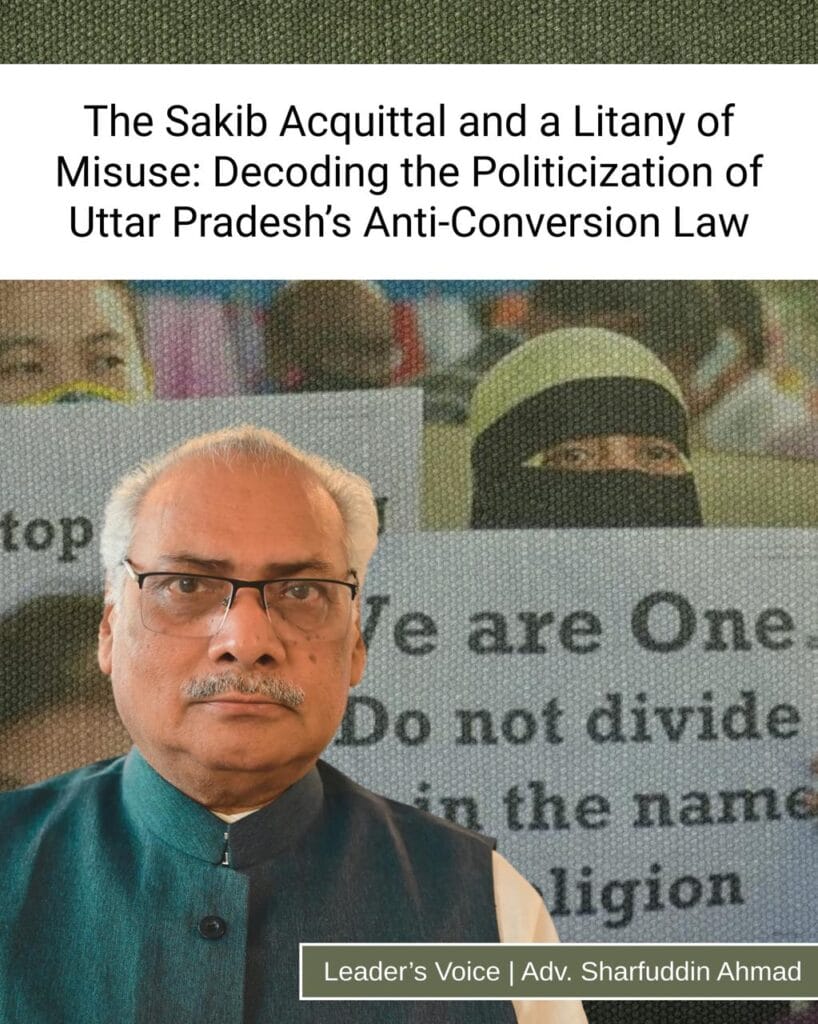
Leader’s Voice | Adv. Sharfuddin Ahmad
The Sakib Acquittal and a Litany of Misuse: Decoding the Politicization of Uttar Pradesh’s Anti-Conversion Law
A Watershed Moment in Bijnor
On May 21, 2025, the Additional District and Session Judge/Special Judge (POCSO) in Bijnor, Uttar Pradesh, delivered a groundbreaking verdict acquitting Mohammad Sakib in Sessions Case 40/2021 (State Government vs. Mohammad Sakib), one of the earliest prosecutions under the Uttar Pradesh Prohibition of Unlawful Conversion of Religion Act, 2020. Presided over by Smt. Kalpana Pandey, this ruling exonerated Sakib, a Muslim accused of luring a minor Hindu girl into marriage and conversion, exposing the systemic misuse of the anti-conversion law to target religious minorities, particularly Muslims and Christians. Hailed as a triumph for justice, the Sakib acquittal illuminates a troubling pattern of politicization, where vague legal provisions and communal narratives like “love jihad” fuel harassment, erode constitutional freedoms, and exacerbate social divides. By examining Sakib’s case alongside a series of other cases, this article underscores the law’s role in communal oppression and the urgent need for reform to uphold India’s secular and democratic ethos.
The Anti-Conversion Law: A Flawed Framework
Enacted by the Bharatiya Janata Party (BJP)-led Uttar Pradesh government in November 2020 as an ordinance and formalized in 2021, the Uttar Pradesh Prohibition of Unlawful Conversion of Religion Act seeks to regulate conversions induced by misrepresentation, force, coercion, undue influence, allurement, or fraud, with a particular focus on marriages framed as “love jihad”—a term alleging Muslim men entice Hindu women into marriage to convert them to Islam. The law mandates a 60-day prior notification to the district magistrate for conversions, invites public objections, and imposes stringent penalties: up to seven years’ imprisonment (or ten for cases involving minors, women, or Scheduled Caste/Scheduled Tribe members) and fines up to ₹50,000. By shifting the burden of proof onto the accused to demonstrate a conversion’s lawfulness, it challenges the constitutional principle of innocence until proven guilty. Critics, including The Wire and PUCL, argue that the law’s vague definitions of “allurement” and “fraud” enable arbitrary enforcement, infringing on the right to freedom of religion (Article 25) and personal liberty (Article 21). The 2024 amendments, which introduced life imprisonment for certain offenses, have intensified concerns, with PUCL decrying them as a political ploy to appease the BJP’s Hindu voter base, a view echoed by The Wire’s analysis of the law’s over 60% acquittal rate from 2020 to 2023.
Mohammad Sakib’s Case: A Microcosm of Misuse
In Sessions Case 40/2021, Mohammad Sakib, a Muslim resident of Kirarkhedi, Dhampur, faced grave accusations of abducting a 16-year-old Hindu girl from the Scheduled Caste Chamar community on December 14, 2020, at 11:00 PM in Beresheda Chauhan, Bijnor. The complainant, Anil Kumar, alleged that Sakib misrepresented himself as a Hindu named Sonu, intending to marry and convert the girl, and attempted sexual assault. The prosecution invoked Sections 354, 363, and 366 of the Indian Penal Code (IPC) for assault, kidnapping, and abduction to compel marriage, Section 8 of the Protection of Children from Sexual Offences (POCSO) Act, Section 3(2)(5) of the Scheduled Castes and Scheduled Tribes (Prevention of Atrocities) Act, and Sections 3/5(1) of the anti-conversion ordinance. The evidence included Anil Kumar’s written complaint, the victim’s statement under Section 164 CrPC, an age certificate confirming her birth date as August 11, 2004, a medical report, and testimonies from seven witnesses, including the complainant, the victim, her mother, and the investigating officer. The case unraveled due to critical inconsistencies: the complainant and victim cited December 14, 2020, in Beresheda Chauhan, while the medical report referenced November 13, 2020, in Naseerpur. The victim’s cross-examination revealed a prior acquaintance with Sakib and no evidence of coercion or assault. Sakib, denying the charges and alleging village rivalry, offered no defense evidence but was acquitted on May 21, 2025, as the prosecution failed to prove the case beyond reasonable doubt, per Elamarti Satyam (1972) and Kalikota High Court in Subhash Mahato vs. State of Jharkhand (2016). The court negated Section 29 of the POCSO Act’s presumption of guilt, canceled Sakib’s bail bonds, and required a new bond for potential appeals. As one of the first cases under the law, Sakib’s acquittal underscores its susceptibility to communal manipulation.
A Cascade of Misuse: Other Cases in Focus
The Sakib case is emblematic of a broader trend, with numerous cases revealing the law’s misuse. In Ruksar v. State of UP & Ors. (2024), the Allahabad High Court quashed charges against an interfaith couple, ruling that the woman’s voluntary conversion to Islam for marriage was lawful, criticizing the law’s overreach in stifling personal freedoms. Drishtijudiciary.com reported a January 24, 2023, case in Moradabad where an FIR alleging unlawful conversion was dismissed due to lack of evidence of coercion, mirroring Sakib’s outcome. Bar and Bench detailed a 2023 UP court acquittal of two men in a false conversion case, where the judge ordered disciplinary action against police for filing baseless charges, highlighting systemic flaws in enforcement. In a 2021 Moradabad case, Scroll.in reported the arrest of a Muslim man for marrying a Hindu woman, despite her affidavit confirming consent; the case collapsed, but the accused endured months of detention. Clarion India recounted a 2022 Bareilly case where a Muslim man was jailed for a consensual relationship, only to be acquitted after the woman’s testimony affirmed her voluntary conversion, a pattern repeated in a 2023 Kanpur case reported by Muslim Mirror, where a Hindu woman in an interfaith marriage was sent to a shelter home despite her consent. Sabrang India documented Vishwa Hindu Parishad (VHP) disruptions of interfaith weddings in 2023, pressuring police to invoke the law, while The Caravan reported over 200 Christian arrests since 2017, often based on unsubstantiated complaints of forced conversions by pastors and community members. The Wire noted that from September 2021 to August 2023, over 33 FIRs were filed by third parties, often Hindu nationalist groups like VHP and Bajrang Dal, with over 60% of cases from 2020 to 2023 ending in acquittals, underscoring the law’s evidential fragility. In a 2022 Ghaziabad case, India Today reported the arrest of a Muslim man for allegedly converting a Hindu woman, but the case was dismissed when she testified to her consensual conversion. A 2023 Lucknow case, cited by Hindustan Times, saw a Christian missionary acquitted after allegations of mass conversions were disproved, with the court noting the complainant’s ties to a Hindu nationalist group.
Judicial Vigilance: Stemming the Tide of Abuse
Judicial oversight has been instrumental in curbing the law’s misuse. The Allahabad High Court, in 2025 rulings, emphasized that the law, intended to maintain public order, must not violate fundamental rights, dismissing cases like Ruksar where conversions were consensual. The Supreme Court, during April 16, 2025, hearings, stressed that anti-conversion laws must align with constitutional protections, a stance that resonates with the Sakib verdict. The 2023 UP court acquittal of two men, with its call for police accountability, and the 2022 Ghaziabad dismissal reflect judicial vigilance. These rulings align with Brahm Swaroop vs. State of UP (2010), which values prompt FIRs but demands evidential rigor, and Amar Prakash vs. State of Uttar Pradesh (2003), which requires the prosecution to prove charges beyond reasonable doubt before shifting the burden to the accused. The Sakib case, by exposing communal prejudice over evidence, reinforces the judiciary’s role as a bulwark against politicized laws.
Legislative Overreach: The 2024 Amendments
The law’s 2024 amendments, which introduced life imprisonment for certain offenses, have amplified concerns about its politicization. PUCL criticized these changes as a calculated move to bolster the BJP’s Hindu voter base, arguing that vague definitions of “allurement” and “fraud” enable arbitrary enforcement. The Wire highlighted the law’s over 60% acquittal rate from 2020 to 2023, suggesting the amendments prioritize political posturing over justice. Cases like Sakib’s, the 2023 Kanpur incident, and the 2022 Bareilly acquittal illustrate how the law’s expanded penalties exacerbate misuse, targeting consensual relationships and minority communities under the guise of protecting public order.
Socio-Political Ramifications: A Fractured Society
The law’s enforcement has deepened communal fault lines, deterring interfaith relationships and fueling tensions. Scroll.in and The Caravan report that the “love jihad” narrative stokes Hindu-Muslim animosity, particularly during election cycles, a tactic evident in the timing of the 2024 amendments. Muslim Mirror and Clarion India detail the harassment of couples, with women often coerced into retracting consensual statements or sent to shelter homes, as seen in the Kanpur, Moradabad, and Bareilly cases. The law’s notification requirement invades privacy, violating Article 21, while its presumption of guilt undermines the principle of innocence. The Sakib case, layering POCSO and SC/ST Act charges with anti-conversion allegations, mirrors tactics in the 2023 UP court and 2022 Ghaziabad cases, where multiple laws maximize harassment despite weak evidence. Sabrang India’s accounts of VHP-led disruptions and PUCL’s August 2024 report on vigilante empowerment highlight a climate of fear for minorities, with Christians and Muslims facing public shaming and violence alongside legal persecution.
Human Cost: The Toll of False Allegations
The human cost of the law’s misuse is staggering. Even when acquitted, as in Sakib’s case, the Moradabad, Bareilly, Ghaziabad, and Lucknow cases, the accused endure prolonged detention, social stigma, and economic hardship. Families are torn apart, as seen in the 2023 Kanpur case, where a woman was separated from her partner despite her consent. The psychological toll on women, pressured to disavow their choices, and the ostracism faced by minority communities underscore the law’s punitive impact. The 2023 UP court’s rebuke of police misconduct and the 2022 Ghaziabad dismissal’s exposure of complainant biases point to a systemic failure to prioritize justice over communal agendas.
Lessons from Sakib and a Call for Reform
The acquittal of Mohammad Sakib, alongside dismissals in Ruksar, the 2023 UP court case, the 2022 Ghaziabad case, the 2023 Lucknow case, and others, offers profound lessons. The Bijnor court’s meticulous evidence evaluation, echoed in Allahabad and Supreme Court rulings, reaffirms the judiciary’s role in countering communal narratives. The high acquittal rate—over 60% per The Wire—underscores the need for legislative reform to clarify vague terms like “allurement” and eliminate provisions eroding fundamental rights. The law’s empowerment of vigilante groups demands state action to curb their influence, as PUCL warns. To address these issues, the law must be amended to prevent abuse, cases should be expedited to minimize detention, FIRs should be restricted to victims or their families, community initiatives should foster interfaith harmony, and annual reports on case outcomes should ensure transparency. These reforms are critical to restoring fairness and protecting India’s pluralistic fabric.
A Path to Justice and Equality
The acquittal of Mohammad Sakib, as one of the first prosecutions under the 2020 ordinance, sets a powerful precedent for challenging the Uttar Pradesh Prohibition of Unlawful Conversion of Religion Act’s misuse. Cases like Ruksar, the Moradabad, Bareilly, Kanpur, Ghaziabad, and Lucknow dismissals reveal a law weaponized for communal oppression rather than justice. The judiciary’s commitment to constitutional principles, evident in Bijnor and higher courts, offers hope, but the law’s broader impact—polarizing communities, eroding freedoms, and harassing interfaith couples—demands systemic reform. Uttar Pradesh must realign its laws with India’s secular and democratic ethos, ensuring justice and equality prevail over prejudice, so that no citizen faces the ordeal endured by Sakib and countless others.

No Comments