
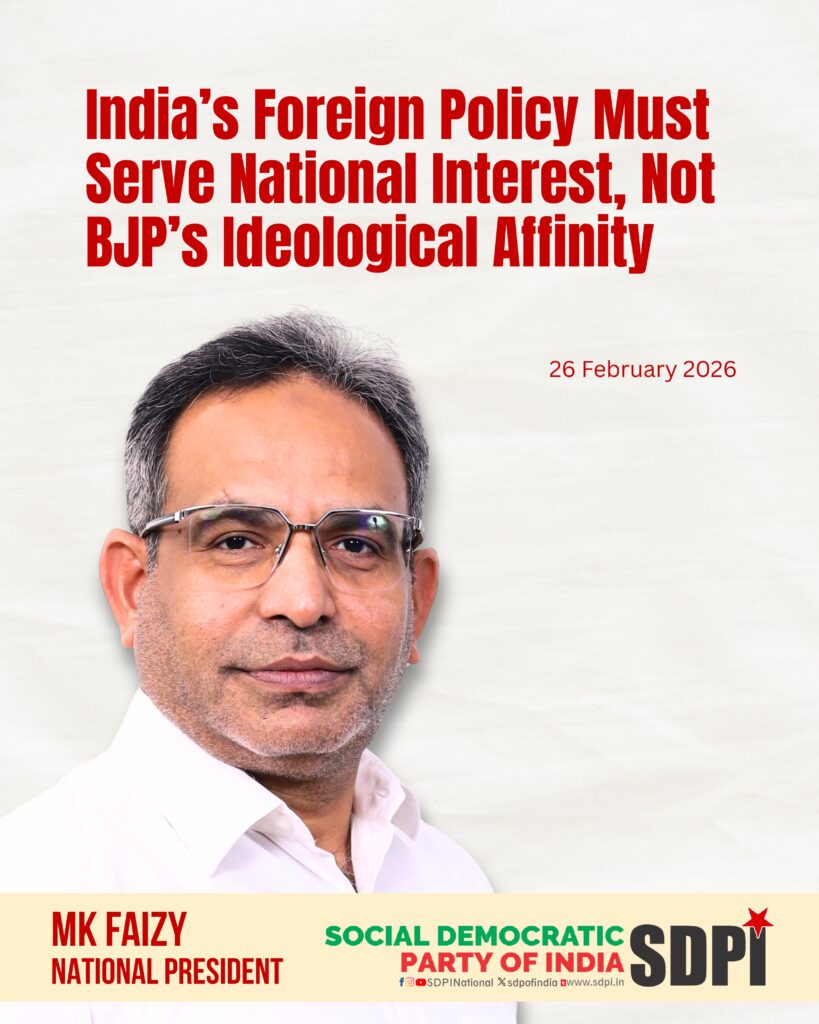
India’s Foreign Policy Must Serve National Interest, Not BJP’s Ideological Affinity
MK Faizy, National President of the Social Democratic Party of India, has strongly criticised Prime Minister Narendra Modi’s ongoing visit to Israel at a time when the Occupied Palestinian Territory continues to endure unprecedented devastation. He stated that this visit marks a significant shift away from India’s historic commitment to justice, balanced diplomacy and strategic autonomy in West Asia. By foregrounding defence cooperation and strategic convergence with Israel while Gaza faces immense humanitarian suffering, the government risks compromising India’s long standing independent foreign policy framework.
For decades, India stood firmly with the Palestinian people. In 1947, India voted against the partition of Palestine. In 1974, it became the first non Arab country to recognise the Palestine Liberation Organisation as the sole legitimate representative of the Palestinian people, and in 1988 it recognised the State of Palestine. This principled position was rooted in anti colonial solidarity and the belief in self determination. Today, however, Gaza has witnessed large scale civilian casualties, including thousands of women and children, destruction of homes, repeated damage to hospitals and medical facilities, and the killing of doctors and humanitarian workers. International agencies have documented widespread displacement, hunger and the collapse of essential services. At such a critical juncture, deepening military and strategic ties with Israel sends a deeply troubling signal.
The Prime Minister has on earlier occasions described Israel as a close friend and strong ally of India, and the present visit further cements that public alignment. Bilateral defence trade between India and Israel runs into billions of dollars, with India being one of the largest purchasers of Israeli military equipment, including missile systems, surveillance technology and unmanned aerial vehicles. This growing partnership, increasingly visible and politically celebrated, represents a departure from earlier calibrated engagement.
The party emphasised that India’s interests require balanced and constructive relations across West Asia. Millions of Indians live and work in Gulf countries, and India’s energy security is closely tied to the region. Any perception that India is tilting decisively toward one side in deeply polarised regional conflicts may carry diplomatic and economic consequences. Rising regional tensions involving Iran further underline the need for prudence, especially given India’s strategic investments such as the Chabahar port and connectivity initiatives linking India to Afghanistan and Central Asia.
The Social Democratic Party of India called upon the government to reaffirm its commitment to a balanced foreign policy rooted in national interest rather than ideological affinity. India must continue to advocate for an immediate ceasefire in Gaza, protection of civilians, accountability for violations of international law, and a genuine revival of the two state solution with East Jerusalem as the capital of a sovereign Palestine.
India’s foreign policy must reflect the conscience, security and long term interests of its people. It cannot be shaped by partisan ideology or symbolic alignments.

No Comments