
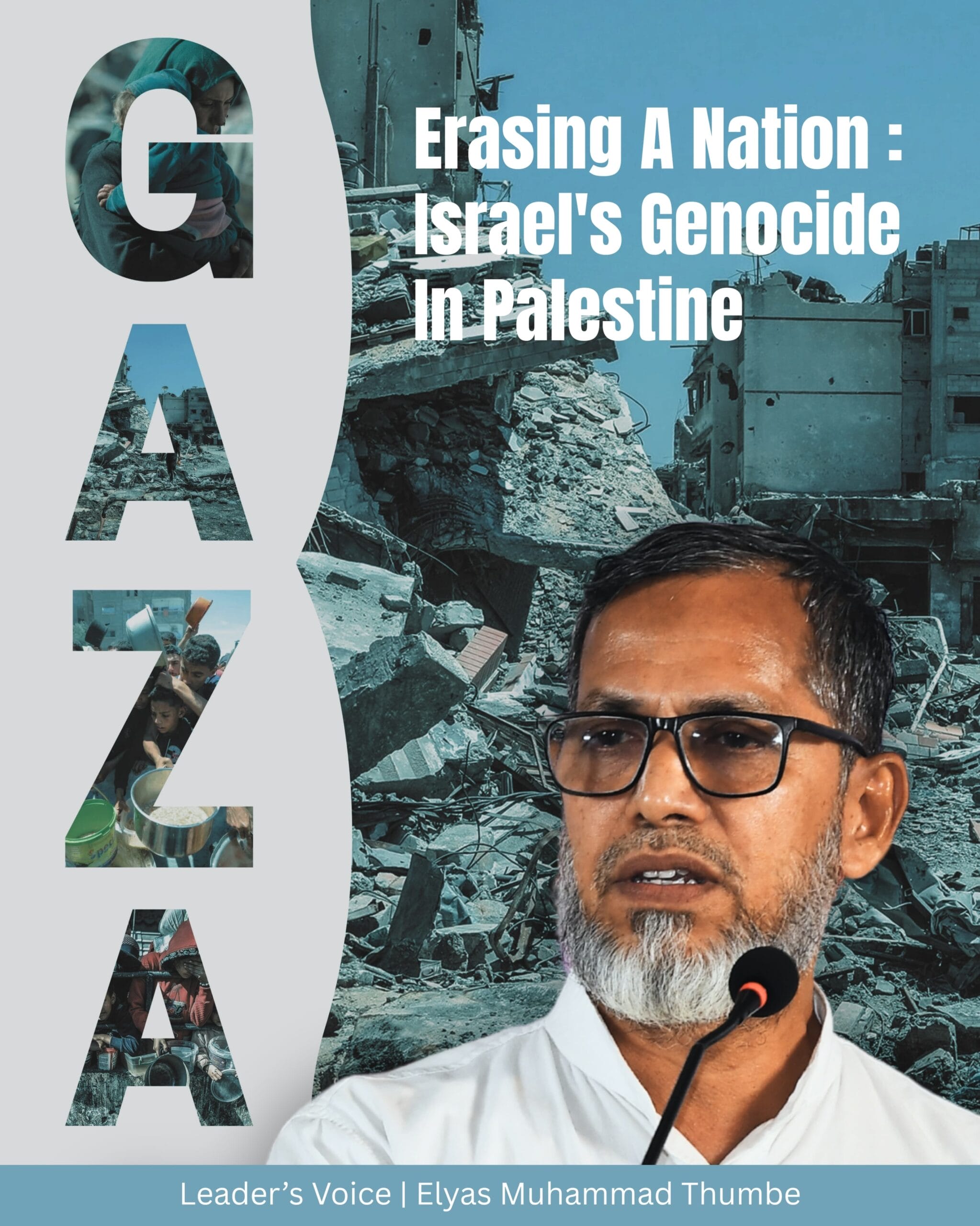
Erasing A Nation: Israel’s Genocide In Palestine
Elyas Muhammad Thumbe
The skies above Gaza are a relentless shroud of gray, choked with the smoke of missiles and the ashes of a people’s dreams. For over a year, this 365-square-kilometer enclave—home to 2.3 million Palestinians—has been transformed into a charnel house, where the wail of sirens and the screams of grieving mothers silence the echoes of morning prayers and children’s laughter. Since January 2025, Israel’s military campaign, codenamed “Operation Gideon’s Chariots,” has escalated a humanitarian catastrophe into a deliberate, systematic genocide. This is not a conflict of equals but a slaughter, waged with advanced weaponry against a stateless, starving population trapped in an open-air prison. This article exposes Israel’s 2025 atrocities—indiscriminate massacres, starvation policies, infrastructure annihilation, and targeted killings of Palestinian leaders and civilians—revealing a calculated effort to erase a nation and the world’s complicity in its silence.
History of the conflict
The Palestinian tragedy is rooted in the 1948 Nakba, when 750,000 Palestinians were forcibly expelled during Israel’s creation, their villages razed to make way for a settler-colonial state. The 1967 Six-Day War entrenched Israel’s occupation of Gaza, the West Bank, and East Jerusalem—territories recognized as Palestinian under international law. The First Intifada (1987–1993) saw over 1,200 Palestinians killed in a desperate uprising against military rule. The Second Intifada (2000–2005) claimed 3,000 Palestinian lives, with civilians bearing the brunt. Since 2007, Gaza’s blockade has suffocated the enclave, with offensives in 2008–2009, 2014, and 2021 killing over 6,000 and leveling entire communities. By June 8, 2025, Gaza’s Health Ministry reported 59,928 Palestinian deaths since October 2023, the deadliest phase of this 77-year campaign of dispossession. These are not isolated acts but a deliberate continuum of ethnic cleansing, each chapter more brutal than the last, aimed at erasing Palestinian existence.
Ceasefire Collapse and Operation Gideon’s Chariots
A ceasefire brokered in January 2025 by Egypt, Qatar, and the UN offered a fleeting hope after 15 months of carnage. It promised the release of 120 Israeli hostages, 12,000 weekly aid trucks, 50 daily fuel trucks, and 150 daily medical evacuations for wounded Palestinians. But on January 17, within 24 hours, Israeli F-35 jets obliterated Al-Shati refugee camp, killing 19 civilians, including seven children. In the preceding week, 86 Palestinians died in preemptive strikes, per Gaza’s Health Ministry. Over the next month, Israel allowed only 8,500 aid trucks—far below the promised 12,000—and 15 fuel trucks daily, blocking tents and rubble-clearing equipment. Medical evacuations dropped to 53 patients daily, leaving hundreds to perish. Amnesty International reported children dying of hypothermia in makeshift shelters, their bodies wrapped in plastic sheets. In the West Bank, Israeli raids in Jenin, Tulkarem, and Tubas killed 47 Palestinians, including two-year-old Aisha al-Ramahi, shot in her Jenin home on February 3, her doll clutched in her lifeless hands. The UN’s Office for the Coordination of Humanitarian Affairs (OCHA) condemned these raids as “war-like,” yet no global intervention followed.
The ceasefire’s collapse on March 18 unleashed Operation Gideon’s Chariots, a campaign of apocalyptic violence. That day, 404 Palestinians were killed in airstrikes and tank assaults, with daily tolls of 87–146 thereafter, totaling 3,200 by June 8. Entire families vanished under rubble, their names etched on a grim tally reaching 59,928. On March 20, the Abu Khalil family’s Rafah home was struck, killing 17, including eight children. Noor Abu Khalil, 14, survived, her voice trembling: “We were eating bread when the missile hit. I dug through the stones, calling for my sister, but only found her hand.” On April 10, a Deir al-Balah strike killed volunteer pharmacist Layla al-Masri and her three children, their bodies found clutching medicine for the elderly. On May 4, Khaled Abu Samra, another pharmacist, died when his clinic was bombed, his last words to a colleague: “Keep the medicine safe.” UNICEF reported 700 children killed and 1,800 injured since March 18, with women and children comprising 60% of deaths.
Starvation and Humanitarian Crisis
Israel’s starvation policy is its most sinister weapon. The March 2, 2025, blockade halted food, water, fuel, and medicine, plunging Gaza into famine. UNRWA documented 72 hunger-related deaths by June, with 310,000 children at risk of starvation. Mothers, too weak to breastfeed, cradled fading infants. On May 19, only five aid trucks entered Gaza—one-tenth of the 500 needed daily. Israeli forces fired on aid seekers, wounding 25 in late May. On May 27, 16-year-old Yusuf Hamdan was shot carrying flour home, his mother, Umm Yusuf, sobbing: “He promised us bread. Now I hold his bloodied shoes.” OCHA reported 52 attacks on aid convoys, killing 28 drivers. Mahmoud Abu Hani, a 29-year-old driver, survived a March 12 attack: “Tanks fired without warning. My brother’s blood soaked the flour we were delivering.” Amnesty International labeled this a war crime under Article 8(2)(b)(xxv) of the Rome Statute.
Aid Attacks
The Gaza Humanitarian Foundation (GHF), backed by the U.S. and Israel, was a cruel deception. On May 31, 2,000 civilians gathered at a Khan Younis GHF site, clutching empty jugs. Israeli tanks opened fire, killing 30 and injuring 150. Over the next week, 39 more died at aid sites, with 220 wounded, per Anadolu Agency. Survivor Fatima al-Zahra, 32, recounted: “Bullets tore through us as we reached for food. My son fell, and the crowd trampled him.” On June 3, a similar attack in Rafah killed 22 aid seekers, including 12 women, their bodies left in the sun for hours, as reported by Middle East Monitor.
Attacks on Hospitals, Schools, and Heritage
Hospitals, Gaza’s last sanctuaries, have been obliterated. On May 13, an airstrike on Al-Shifa Hospital destroyed its water and sewage systems, leaving patients drinking contaminated water. Satellite imagery revealed mass graves with 120 bodies—patients, doctors, and children—some with execution-style wounds. On April 9, Al-Amal Hospital in Khan Younis was hit, killing 12 staff, including pediatrician Dr. Fatima al-Najjar, whose final post read: “We die to save others. Where is humanity?” By June 2025, no northern Gaza hospital functions, violating Article 8(2)(b)(ix) of the Rome Statute. Schools, too, are targets: on April 28, Al-Zaytoun School, sheltering 3,000, was bombed, killing 41, including 19 children. The 7th-century Great Omari Mosque, destroyed on April 15, joined 80% of Gaza’s mosques in rubble, erasing centuries of heritage.
Forced displacement
Forced displacement has uprooted thousands, with 70% of Gaza labeled “no-go zones.” Evacuation orders for Khan Younis and Rimal on April 10 forced families to flee under fire. Amal Qassem, 45, described: “We walked 10 kilometers, my grandson crying for water. The south was bombed too.” Human Rights Watch (HRW) called this systematic displacement, potentially a crime against humanity under Article 7(1)(d). Israeli Minister Bezalel Smotrich’s March 2025 call for Palestinians to leave for “third countries” fueled accusations of a depopulation plan, per the Gaza Government Media Office.
Targeted Killings
Targeted killings aim to decapitate Palestinian society. Journalists face relentless attacks: on March 2, Hossam Shabat, 27, was killed in Beit Lahia, his camera shattered. On April 18, Tamer Meqdad died in Tal al-Zaatar, his six-year-old daughter, Laila, in his arms. On May 14, Hassan Aslih was killed near Nasser Hospital, part of a day claiming 80 lives. The Committee to Protect Journalists notes 127 journalists killed since October 2023. Humanitarian workers are not spared: on May 28, Mohammad Al-Mubayed of the Turkish IHH Relief Foundation died in a drone strike on Al-Nafaq street. Survivor Amina Khalil said: “Our vests said ‘HUMANITARIAN.’ They fired anyway.” Religious leaders like Sheikh Naael Musran, killed in his Rafah tent on May 28, and 500 scholars have been erased. Salah al-Bardawil, a Hamas official, died with his family on March 23. Civilians suffer equally: on May 19, Ahmad Sarhan was executed in Khan Younis, his family abducted. The May 31 Khan Younis aid site massacre killed 93, including 42 children.
Diplomatic sabotage
Israel’s diplomatic sabotage is blatant. On June 14, it blocked a Saudi-led delegation, led by Faisal bin Farhan, from entering the West Bank, a move the Arab League called “diplomatic terrorism.” The U.S. vetoed a June 4 UN Security Council ceasefire resolution, despite support from 14 members, including France and Japan. The ICC’s November 2024 arrest warrants for Benjamin Netanyahu and Yoav Gallant, and the ICJ’s genocide probe, remain unenforced. The U.S.’s $3.8 billion annual aid to Israel, including bombs leveling Gaza, underscores global complicity.
I demand an immediate UN-mediated ceasefire, ICC prosecutions, sanctions on Israel, and support for Palestinian statehood with East Jerusalem as its capital. Israel’s 2025 campaign—59,928 deaths, famine, and erasure—is a genocide rooted in 77 years of oppression. History will judge us by our actions. Let it record we fought for a people who refused to be erased.
(Elyas Muhammad Thumbe is the National General Secretary of the Social Democratic Party of India, advocating for global justice and Palestinian rights.)

No Comments