
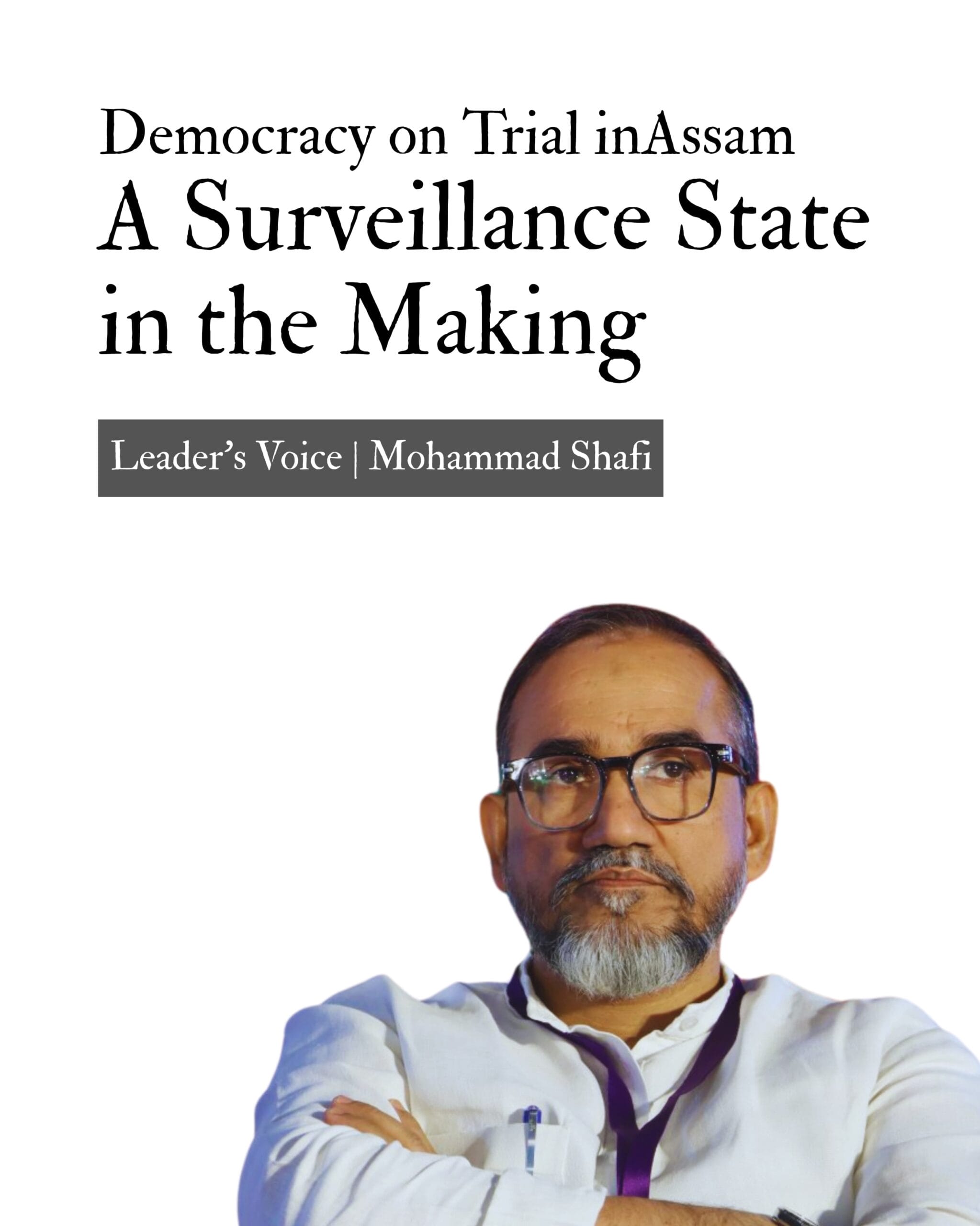
Democracy on Trial in Assam: A Surveillance State in the Making
Leader’s Voice | Mohammad Shafi
In the lush hills and riverine plains of Assam, a northeastern Indian state renowned for its tea estates and cultural diversity, a storm has been brewing since the spring of 2025. What began as a response to a distant tragedy—a terror attack in Pahalgam, Jammu and Kashmir, on April 22, 2025, claiming 26 lives—has escalated into one of the most divisive campaigns in modern Indian history. Under the banner of “Operation Sindoor,” Assam’s Chief Minister Himanta Biswa Sarma, leader of the Bharatiya Janata Party, has launched a sweeping crackdown on social media posts deemed “anti-national” or offensive to religious sentiments. By June 17, 2025, at least 92 individuals, predominantly Muslims, have been arrested, their alleged crimes ranging from expressing sympathy for Pakistan to critiquing India’s military actions or disrespecting Hindu deities. This narrative weaves together the voices of the detained, the legal battles, the political feuds, and the communal tensions that have placed Assam at a crossroads, testing the resilience of India’s democratic ideals.
The Spark: A Terror Attack and a Digital Reckoning
The genesis of Operation Sindoor lies in the aftermath of the Pahalgam attack, widely attributed to Pakistan-based militants. The tragedy, which shook India and prompted a military response on May 6-7, 2025, in Pakistan and Pakistan-occupied Kashmir, reverberated far beyond the conflict zone. In Assam, a state geographically distant from Kashmir but historically sensitive to issues of identity and security, Chief Minister Sarma seized the moment to pivot the national outrage inward. On April 24, 2025, he took to the social media platform X, declaring a war on “Pakistani sympathizers” who, he claimed, were undermining India’s sovereignty through online posts. His words were unequivocal: “Nobody will be spared.”
Within days, the Assam Police launched Operation Sindoor, a coordinated effort to monitor and act against social media content deemed “anti-national.” The first high-profile arrest was that of Aminul Islam, a legislator from the All India United Democratic Front (AIUDF), detained on April 24. His arrest sent a chilling message: no one, not even elected officials, was beyond the reach of this campaign. By April 29, 36 individuals had been detained; by May 11, the number climbed to 70, and by June 17, it reached at least 92, with arrests spanning districts like Sonitpur, Kamrup, Lakhimpur, Dhubri, and Cachar. The detainees, mostly Muslims, included students, farmers, and daily wage earners, their alleged offenses often as vague as shouting “Pakistan Zindabad” or critiquing India’s military response.
As the arrests mounted, questions emerged about the operation’s scope and legality. What constituted an “anti-national” post? Were these detentions grounded in law, or were they a manifestation of state overreach? To answer these, one must navigate the legal and constitutional terrain that Operation Sindoor has exposed—and the fault lines it has deepened.
The Legal Quagmire: Free Speech vs. National Security
At the heart of Operation Sindoor lies a fundamental tension in India’s democracy: the right to free speech, enshrined in Article 19(1)(a) of the Constitution, versus the state’s authority to impose “reasonable restrictions” under Article 19(2) for reasons of sovereignty, security, or public order. The Supreme Court’s 1962 ruling in Kedar Nath Singh vs. State of Bihar established a high threshold for sedition, requiring clear intent to incite violence or disrupt public order. Yet, in Assam, the application of laws like sedition (Section 150 of the Bharatiya Nyaya Sanhita, 2023) and the National Security Act (NSA), 1980, has raised serious concerns about overreach. Advocate AR Bhuyan, a Guwahati-based legal expert, stated, “Mere support for another country or criticism of India—without incitement to violence or public disorder—does not constitute a cognizable offence.” This view aligns with recent judicial rulings. On June 10, 2025, the Calcutta High Court granted interim bail to Sharmistha Panoli, a law student arrested in Gurugram for remarks linked to Operation Sindoor, noting that her FIR failed to disclose a cognizable offense. Similarly, Ashoka University professor Ali Khan Mahmudabad, detained on May 19 for his posts, secured interim bail from the Supreme Court on May 21, further questioning the crackdown’s legal foundation.
The Assam Police’s refusal to disclose the specific content of offending posts has fueled skepticism. In some cases, the NSA—a law allowing preventive detention for up to 12 months without trial—has been invoked, as seen with Aminul Islam, who was re-detained under the NSA after securing bail on sedition charges. Such punitive measures, coupled with the lack of transparency, suggest a troubling erosion of due process. By June 2025, the crackdown expanded beyond “pro-Pakistan” posts to include content deemed offensive to Hindu deities, particularly Goddess Kamakhya, a revered figure in Assam’s spiritual landscape. Arrests under Section 295A of the Bharatiya Nyaya Sanhita, for outraging religious feelings, marked a shift toward policing communal sentiments. The arrest of 18 individuals on June 15 for alleged “illegal cattle slaughter” during Eid-ul-Adha further underscored this trend, raising alarms about communal profiling in a state where Muslims constitute roughly 40% of the population.
The Political Theater: Sarma vs. Gogoi
While Operation Sindoor unfolded on the ground, a parallel drama electrified Assam’s political arena, pitting Chief Minister Sarma against Gaurav Gogoi, the newly appointed president of the Assam Pradesh Congress Committee and Deputy Leader of Opposition in the Lok Sabha. On May 26, 2025, Gogoi’s elevation signaled Congress’s intent to challenge the BJP’s dominance ahead of the 2026 Assembly elections. Sarma, a former Congress leader who defected to the BJP in 2015, responded with a barrage of accusations, alleging that Gogoi had “links with the Pakistan establishment.” The allegations centered on Gogoi’s 2013 visit to Pakistan, which Sarma claimed was facilitated by Pakistan’s Ministry of Interior, a body overseeing the Inter-Services Intelligence (ISI). Sarma further implicated Gogoi’s wife, Elizabeth Colburn, a British public policy expert who lived in Pakistan in 2013 for a climate change project, alleging she maintained ties with Pakistani intelligence until 2017-18. Promising to unveil evidence on September 10, 2025, following a Special Investigation Team (SIT) probe, Sarma also summoned former Congress MP Ripun Bora for questioning.
Gogoi, known for his measured demeanor, dismissed the accusations as a “C-grade Bollywood movie” plot. He clarified that his 2013 visit was personal, aimed at meeting his wife during her climate change project, and had no intelligence connections. Challenging Sarma to release evidence immediately, Gogoi pointed out that BJP stalwarts like LK Advani and Prime Minister Narendra Modi had also visited Pakistan, accusing Sarma of orchestrating a smear campaign to distract from governance failures like unemployment and flood mismanagement.
This feud has galvanized Assam’s political landscape. Sarma’s accusations tap into historical anxieties about illegal immigration and foreign influence, particularly from Pakistan and Bangladesh, resonating with the BJP’s nationalist base. Conversely, Gogoi’s supporters, including Congress leaders and independent analysts, argue that the allegations are a desperate bid to neutralize a formidable opponent. Ripun Bora suggested that Sarma fears Gogoi’s potential as a chief ministerial candidate, a sentiment echoed by observers who see Operation Sindoor as a broader strategy to consolidate BJP’s grip on Assam.
A Community Under Siege
The human toll of Operation Sindoor is most acutely felt in Assam’s Muslim communities, particularly in districts like Dhubri, Cachar, and Darrang, where arrests have been concentrated. Families of detainees, often daily wage earners or small-scale farmers, describe a climate of fear and economic hardship. “My brother posted a comment about the Kashmir situation, nothing violent,” said a relative of a detainee in Lakhimpur, speaking anonymously to The Indian Express. “Now he’s in jail, and we don’t know when he’ll be released.” The lack of transparency—neither the police nor the government have released detailed charges or evidence—has left families grappling with uncertainty.
The crackdown’s communal undertones are undeniable. Sarma’s repeated references to “Pakistani sympathizers” and the exclusive targeting of Muslims for “pro-Pakistan” posts have raised alarms about profiling. The arrests for cattle slaughter and remarks against Hindu deities have deepened mistrust, particularly after protests erupted in Muslim-majority areas following the Eid-ul-Adha incidents on June 15. Community leaders accuse the government of weaponizing cultural practices to marginalize minorities, a perception compounded by Sarma’s broader policies, such as enforcing the Immigrants (Expulsion from Assam) Act, 1950, and arming indigenous communities in border areas. In rural districts, the economic fallout is stark. Detainees’ families, reliant on meager incomes, have sold assets like cattle and jewelry to cover legal fees, while markets in Muslim-majority areas like Dhubri and Hojai have seen sharp declines in foot traffic.
The Digital Battleground
Operation Sindoor’s reliance on social media monitoring marks a new frontier in India’s policing of dissent. The Assam Police, in collaboration with the SIT and the National Investigation Agency (NIA), have deployed sophisticated tools to track posts in real time, flagging keywords and analyzing IP addresses. Sarma’s claim that 1,000-2,000 accounts, many allegedly operated from Pakistan and Bangladesh, are under scrutiny suggests the use of algorithmic surveillance, though no public evidence has linked detainees to organized threats. This digital dragnet has cast a chilling effect on free expression. Social media, once a vibrant space for debate in Assam, has become a minefield. A college student in Guwahati told The Hindu, “I used to post about politics, but now I’m scared. Even sharing a news article could be dangerous.”
The crackdown’s expansion to communal content, such as posts about Goddess Kamakhya, has further narrowed the boundaries of acceptable speech, leaving citizens uncertain about what might trigger an arrest. The case of Wajahat Khan Qadri, who filed a complaint against Sharmishta Panoli but was later detained for communal remarks, underscores the operation’s chaotic scope, ensnaring even its proponents.
The Road Ahead: A Test for Democracy
As Assam approaches the 2026 Assembly elections, Operation Sindoor stands as a defining moment in the state’s trajectory. For Sarma, the crackdown is a calculated gamble: a show of strength that bolsters his image as a nationalist while neutralizing opposition voices. The allegations against Gogoi, if substantiated by the SIT’s September 2025 report, could reshape Assam’s political landscape. But if the evidence falls short, as Gogoi predicts, Sarma risks accusations of defamation and overreach, potentially galvanizing Congress’s base.
The judiciary holds a pivotal role. Rulings like those in the Panoli and Mahmudabad cases signal skepticism about the crackdown’s legal foundations, but the NSA’s use limits recourse, leaving many detainees in limbo. The lack of transparency—neither Sarma nor the police have released detailed evidence—undermines public trust, placing the burden on courts to uphold accountability.
For Assam’s Muslim minority, the crackdown is a stark reminder of their precarious place in a state grappling with identity and security. The arrests, communal rhetoric, and cultural policing threaten to deepen divides, echoing the ethnic strife of the 1980s when anti-immigrant agitations turned violent. The operation’s legacy will hinge on whether the government can balance security imperatives with democratic principles of free speech and equality.
A Nation at a Crossroads
Operation Sindoor is more than a crackdown on social media posts; it is a microcosm of India’s struggle to reconcile national security with civil liberties. In Assam, where history is marked by ethnic and communal volatility, the stakes are high. Sarma’s campaign has spotlighted the power of state machinery to shape narratives and silence dissent, but it has also ignited a counter-narrative, led by voices like Gogoi, who demand transparency and justice. As the SIT’s deadline looms and courts weigh in, India watches closely. Will Assam’s crackdown be remembered as a necessary defense against external threats, or as a cautionary tale of democracy eroded under the guise of security? For the 92 individuals detained, their families, and a state on edge, the answer is not just a matter of policy but of survival.

No Comments