
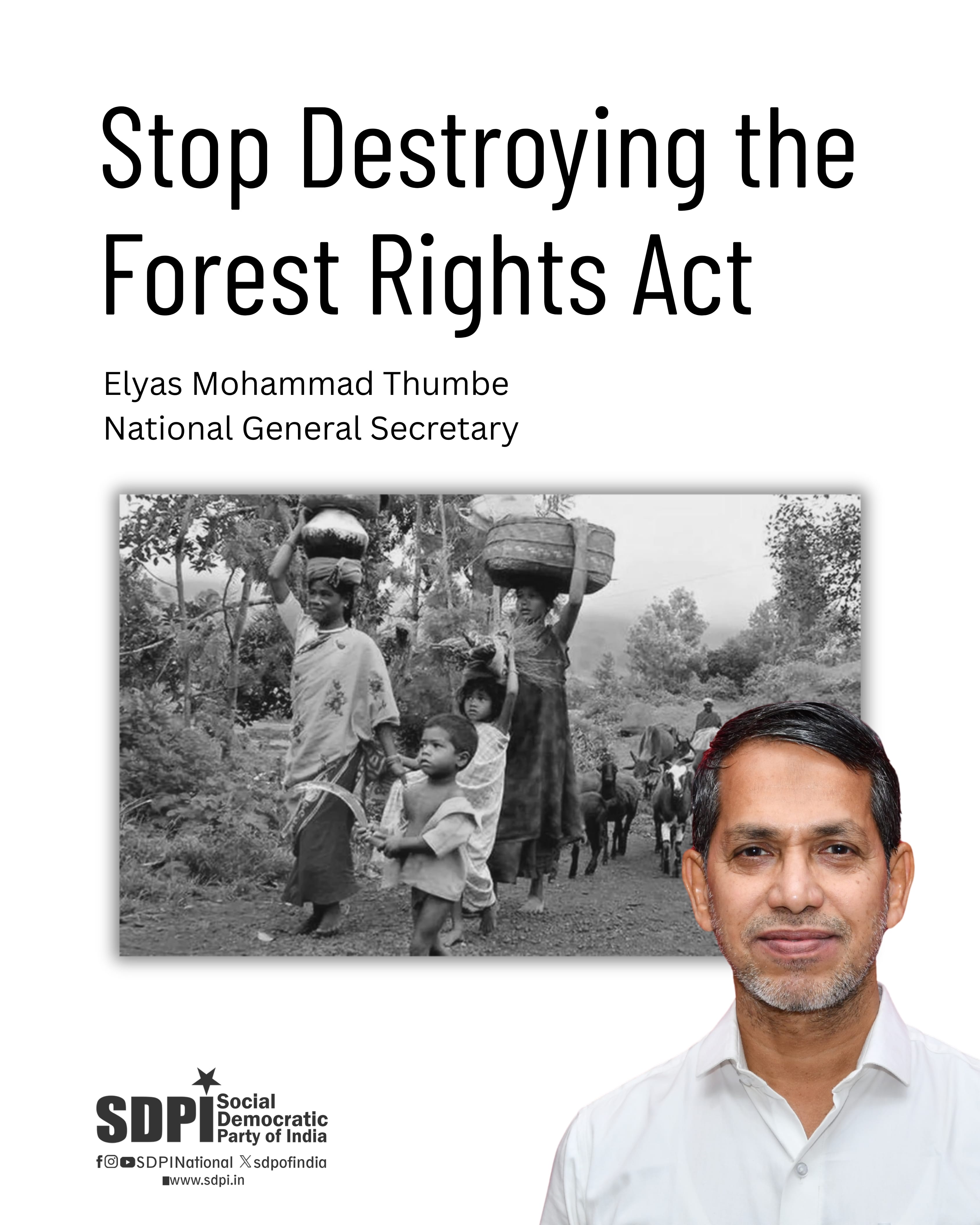
Stop Destroying the Forest Rights Act
Some of the most important legislations in India’s history, the Forest Rights Act (FRA) and the Right to Information Act (RTI) which have empowered the most marginalised sections of Indian people as well as the ordinary citizens of the country, are now facing serious challenges in the form of arbitrary executive actions that could erode their effectiveness.
The Scheduled Tribes & Other Traditional Forest Dwellers (Recognition of Forest Rights) Act was enacted in 2006 to protect the rights of the traditional forest dwellers like adivasis, who faced immense persecution and loss of their habitats during time of colonial administration as well as during the days of independence. As a result, a large number of adivasis were forced to become internal refugees, and the constant attack on their livelihoods was one of the reasons for the rise of violent and extremist movements in many tribal regions of India. The state had been tackling these problems simply as a law and order issue with a massive deployment of armed forces into these regions.
Though the FRA could not stop such wanton acts of state terrorism on the adivasi people, the legislation gave them rights to protect their traditional habitats and forest lands which were being converted into industrial and commercial properties for various activities like mining, setting up of vast industrial units and government establishments like police camps, etc. None of these activities on the part of the administration as well as the private sector helped the tribal people in any way, as they were being treated as unwanted and disposable ones in their own homelands. However, the FRA helped them fight some of these onslaughts in recent years, as seen in the historic win of Odisha’s Dongria Kondh community over the hills of Niyamgiri where the UK-based Vedanta group had planned to launch massive mining operations.
But ever since the Narendra Modi Government came to power at the Centre in 2014, the approach of the government apparatus appears to have undergone a substantial transformation. The pro development lobby in the Government appears to have taken an upper hand, and they are now encouraged to take more adventurous actions depriving the adivasis of their rights in many remote parts.
One such glaring example of wanton developmental blitzkrieg is now ongoing in the islands of Andamans & Nicobar, where some of the most vulnerable sections of adivasis are living. Many of these tribal groups keep totally isolated from the outside world and they are prone to debilitating diseases in case outsiders are allowed into their abodes. Any such intrusion would end up in the genocidal extinction of these communities.
It is in these circumstances that the Central Government is going ahead with its massive development project in the islands of Great Nicobar with the setting up of a trans-shipment port, an airport, a power plant and a township. It also has plans for a major highway cutting through the dense forests linking all the major islands in the Bay of Bengal island cluster. It is a multibillion dollar project that would make some of the Indian and foreign corporates much more wealthy at the cost of the tribal people.
For the Great Nicobar project, the government seeks to take over 13,000 hectares of forest lands driving out the traditional residents in those areas. As per the FRA rules, taking over forest lands must get the consent of the traditional dwellers in those parts and this is a long drawn process which should be carried out through various elaborate processes such as meetings of the grama sabhas or village community groups which are bound to take decisions based on informed discussions.
But the Centre has simply forgone such elaborate processes in the Great Nicobar project, commissioning a consent from the Nicobar Administration without any consultations with tribal bodies. As per the reports in national media, the Deputy Commissioner of Nicobar had certified in August 2022 that all rights under the legislation had been identified and settled and consent obtained from the concerned people for conversion of forest lands. As per the letter, there are no hurdles for the implementation of the project.
This claim has been totally baseless and untrue, as the Tribal Council of Little and Great Nicobar has pointed out that none of the processes under FRA had been ever carried out in the islands, let alone settling the claims of residents and obtaining consent from them. Now the matter is under the consideration of the Calcutta High Court which has jurisdiction over the islands.
But what is worrying is the attitude being taken by the Tribal Affairs Ministry of the Central Government which is the nodal agency to safeguard the rights of the forest dwellers and other people dependent on forests as per the provisions of the FRA. According to reports, the Ministry has filed an affidavit in the High Court asserting that it has no such role in the FRA administration as the implementation of the FRA provisions is the sole responsibility of the State Governments and administrations in the Union Territories. In fact, it has objected to the High Court summoning it as a respondent in a case filed in the Calcutta High Court over the Great Nicobar project and resultant forest destruction.
This is a clear case of abdication of responsibilities on the part of a Central Ministry tasked to uphold the rights of the adivasi people in every part of the country. It is a matter of shame that the Ministry claims it has no responsibility, passing the buck to the States and Union Territories, where pressure from the private development lobby could be much more severe and justice for affected people next to impossible to get. It is a deeply disturbing situation that is emerging from the Nicobar island tribals’ case. Unlike Dongria Kondhs in Odisha who were able to win their rights after a long drawn litigation carried up to the Supreme Court, the plight of Nicobar tribal people appears to be much more difficult as even the custodians of their rights are taking a line abandoning them to their fate.
This is sheer irresponsibility on the part of the Union Tribal Affairs Ministry and its minister Jual Oram, himself a well known tribal leader, who are shirking responsibility under political pressure. The Ministry in the past had taken tough actions to protect the rights of forest dwellers and even in the present case, the Minister had said they would look into the complaints of the Nicobar tribal groups.
Now why are they taking a different line? The only explanation is that they are under tremendous political pressure from the top. It is a moot question whether the Prime Minister’s Office is twisting their arms. When the interests of certain powerful corporates are involved, it is no wonder all rules are thrown to the winds. So when it comes to the Rs. 81,000 crore airport and seaport project at Nicobar, one can see the hidden hands that no rule is able to stop. But unfortunately, this is going to be the beginning of the end of FRA, a legislation that sought to protect our traditional forest dwellers and tribals, perhaps the most vulnerable sections of Indian citizens.
Elyas Muhammad Thumbe
National General Secretary

No Comments