
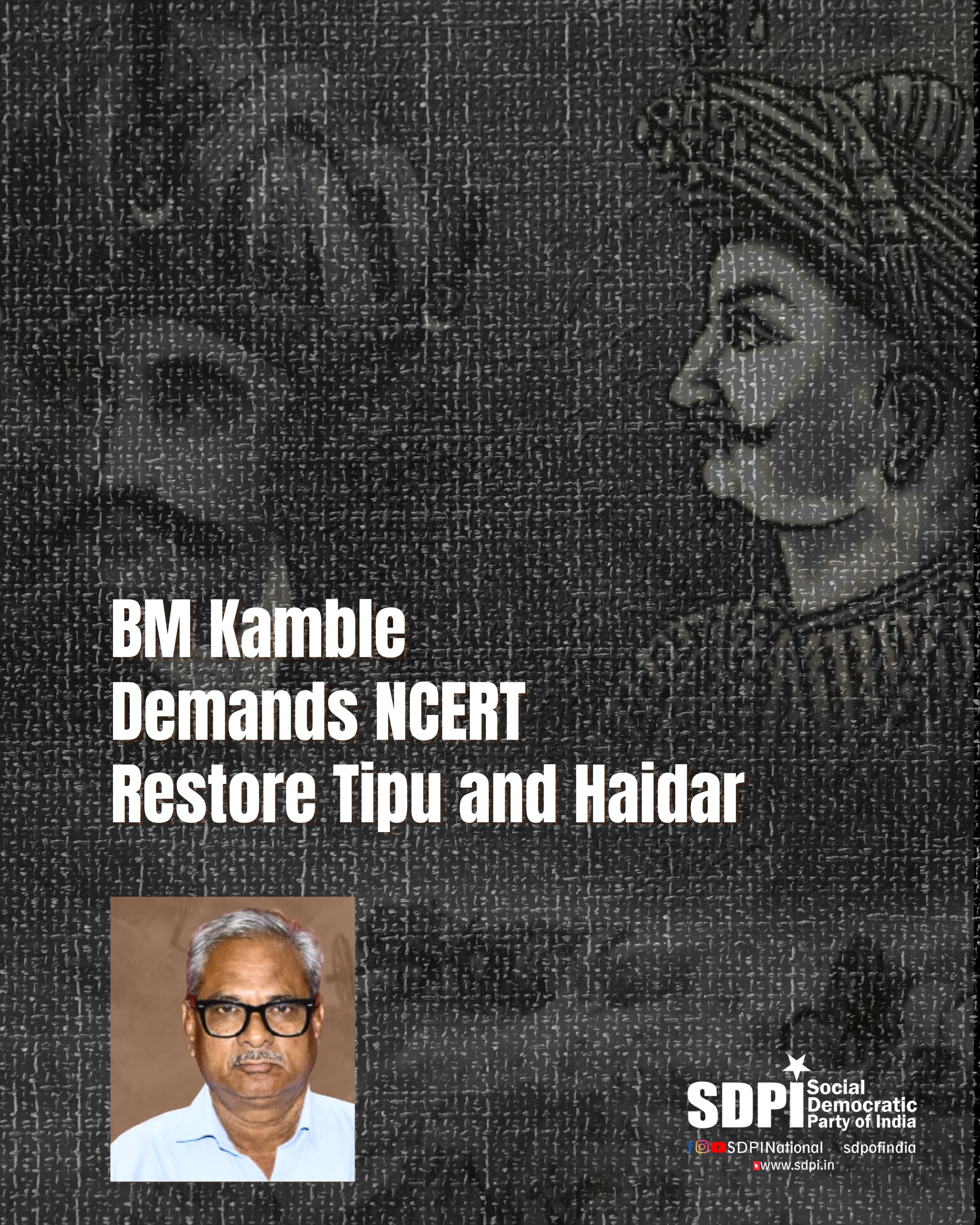
BM Kamble Demands NCERT Restore Tipu and Haidar
BM Kamble, National Vice President of the Social Democratic Party of India, strongly condemns the NCERT’s newly revised Class 8 Social Science textbook, Exploring Society: India and Beyond – Part 1, for deliberately omitting Tipu Sultan, Haidar Ali, and the Anglo-Mysore Wars (1767–1799) from its chapter on the colonial period. This erasure distorts India’s anti-colonial history and marginalizes southern India’s critical role in resisting British imperialism.
Just yesterday, the SDPI criticized NCERT for portraying the Mughals primarily as brutal rulers while downplaying their cultural contributions. This latest omission further exposes a Hindu nationalist agenda that curates history selectively to diminish Muslim contributions. The exclusion of two of southern India’s most prominent Muslim rulers,Tipu Sultan and Haidar Ali and portraying the Mughals solely as tyrants, raises a serious and troubling question: Is history being filtered through the lens of religion?
Earlier NCERT textbooks, such as Our Pasts–III, included detailed accounts of Haidar Ali’s military leadership, Tipu Sultan’s pioneering use of Mysorean rockets, and their fierce resistance to British expansion, culminating in the fall of Seringapatam in 1799. Educational platforms like LearnCBSE (October 2, 2019) and Vedantu (November 25, 2021) also highlighted Tipu as a powerful symbol of anti-colonial defiance.
The revised textbook, however, shifts focus to events such as the Battle of Plassey and northern uprisings like the Sannyasi-Fakir and Santhal rebellions. A separate chapter glorifies Maratha resistance, reinforcing a distinctly north-centric narrative. Coupled with the distorted portrayal of the Mughal era, this reflects a deliberate and dangerous bias. Michel Danino, who oversaw the textbook’s development, has claimed that detailed colonial history, including the Mysore resistance, has been deferred to Classes 9–12. Yet, this justification does not explain the complete omission of such a pivotal episode of resistance at the middle school level.
This exclusion risks fostering a skewed and incomplete understanding of India’s freedom struggle—one that prioritizes Maratha and northern narratives while sidelining the legacy of Mysore. It reflects a broader pattern of curriculum revision under the National Education Policy 2020 which, despite professing inclusivity, appears to promote a Hindu-centric view of history.
The SDPI demands the immediate reinstatement of Tipu Sultan and the Anglo-Mysore Wars in the curriculum, drawing on previously approved NCERT content. We call on the NCERT to engage credible historians through a transparent review process to correct these distortions. We urge educators and citizens to resist this rewriting of history and uphold our pluralistic heritage. India’s educational system must reflect the full diversity of its past.

No Comments