
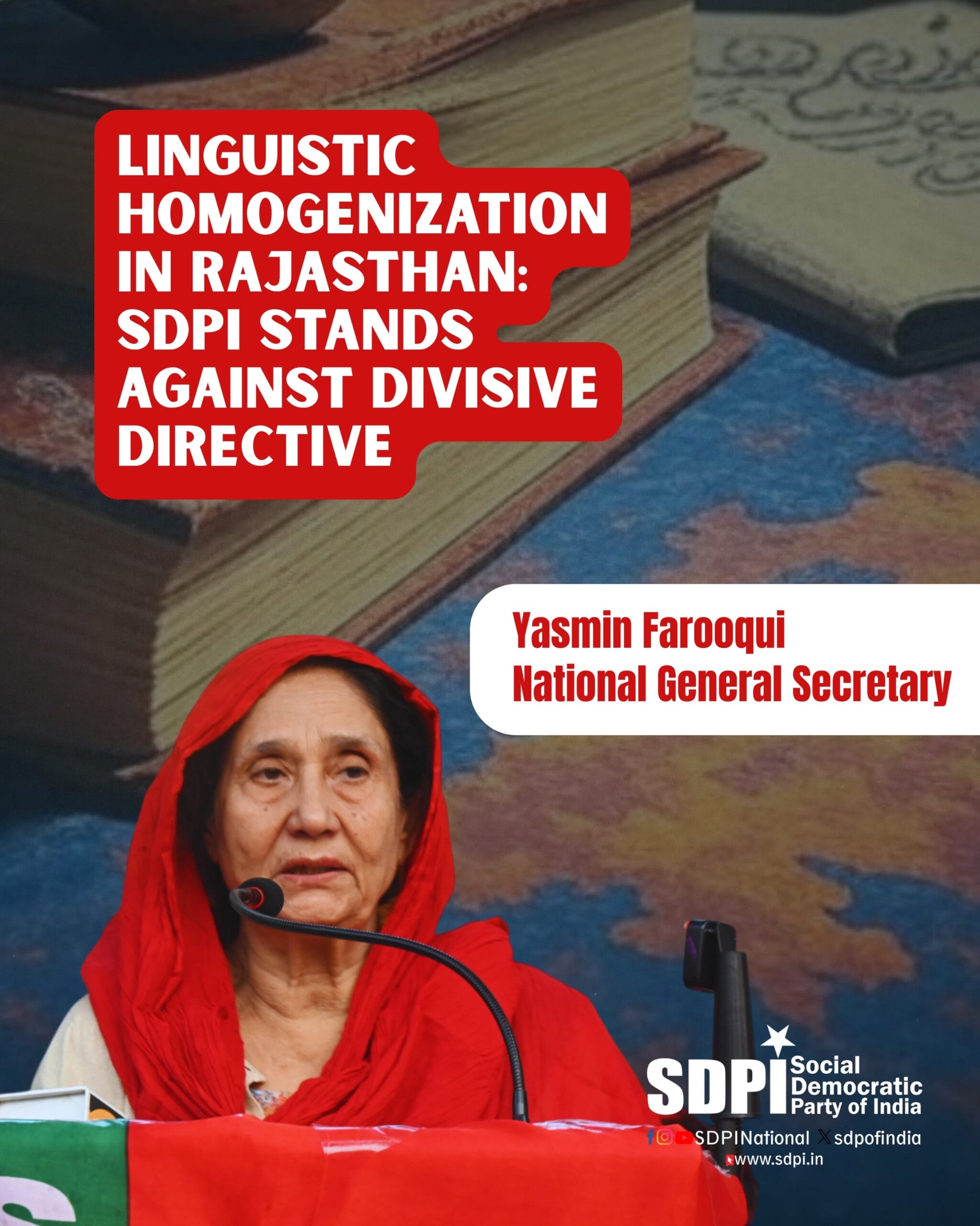
Linguistic Homogenization in Rajasthan: SDPI Stands Against Divisive Directive
Yasmin Faroiqui, National General Secretary of the Social Democratic Party of India, vehemently condemns the Rajasthan government’s directive to replace Urdu and Persian words with Hindi in police documents. While the government claims this move addresses administrative inefficiencies and delays in justice, the SDPI views it as a thinly veiled attempt to advance a political agenda that undermines India’s linguistic and cultural diversity. We believe the directive’s stated rationale—simplifying language to enhance accessibility—lacks empirical support. No credible data links Urdu and Persian terms to quantifiable delays in justice, and the selective targeting of these languages, while ignoring complex English or Latin legal terms, exposes a deeper motive. The directive’s emphasis on the Mughal-era origins of these terms, as articulated by Minister Jawahar Singh Bedham, invokes a divisive historical narrative that risks portraying Urdu as alien to India’s identity, despite its status as a constitutionally recognized language born on Indian soil.
The Bharatiya Janata Party (BJP)-led Rajasthan government’s push for “shudh Hindi” aligns with similar policies in Chhattisgarh, Madhya Pradesh, and Uttar Pradesh, reflecting a broader agenda of linguistic homogenization rooted in cultural nationalism. This move follows Rajasthan’s earlier efforts to merge Urdu-medium schools and eliminate Urdu proficiency requirements for administrative roles—actions that have already marginalized Urdu-speaking communities. Such policies disproportionately affect Muslims, for whom Urdu holds deep cultural significance, and fuel perceptions of deliberate erasure of their heritage. The Delhi High Court’s 2019 rulings, which permitted simple Urdu terms while discouraging archaic ones, offer a balanced approach that Rajasthan has ignored in favor of a blanket replacement. This selective focus, coupled with the lack of consultation with linguistic scholars, legal experts, or Urdu-speaking communities, underscores the communal undertones of the decision.
We stand in solidarity with the Rajasthan Urdu Teachers Association and others who have rightly called this an attack on Urdu’s cultural significance. The SDPI demands the immediate withdrawal of this directive and calls for a transparent, inclusive process to reform legal terminology, involving stakeholders from all linguistic communities. India’s strength lies in its pluralistic heritage, and we will not stand by as divisive policies seek to erase the contributions of any community.

No Comments