
Leader’s Voice | BM Kamble
Debunking the BJP’s Claim to Ambedkar’s Legacy: A Historical and Political Analysis
Introduction
Dr. Bhimrao Ramji Ambedkar, the architect of India’s Constitution and a relentless advocate for social justice, is a towering figure whose legacy transcends political boundaries. Yet, in recent years, the Bharatiya Janata Party has audaciously claimed ownership of Ambedkar’s ideals, particularly during Ambedkar Jayanti celebrations in April 2025. The BJP’s narrative—promulgated through events, speeches, and media campaigns—paints the party as the true inheritor of Ambedkar’s vision, accusing the Congress and others of historically neglecting him. This article argues that the BJP’s claims are not only historically baseless but also represent a deliberate distortion of Ambedkar’s legacy for electoral gain, particularly to woo the Dalit vote bank. By examining historical evidence, Ambedkar’s ideological positions, and contemporary political maneuvers, we dismantle the BJP’s narrative and expose its contradictions.
Historical Disconnect: Ambedkar and Hindutva Ideology
Dr. Ambedkar’s life (1891–1956) was defined by his fight against caste oppression, his advocacy for Dalit rights, and his vision of a society rooted in equality, liberty, and fraternity. His ideological framework, articulated in works like Annihilation of Caste (1936), directly challenged the hierarchical structures of Hindu society, which he saw as perpetuating caste oppression. This stance placed him at odds with the ideological precursors of the BJP, particularly the Rashtriya Swayamsevak Sangh (RSS), the parent organization of the BJP, founded in 1925.
Opposition to the Hindu Code Bill
One of the starkest examples of this disconnect is the RSS’s opposition to the Hindu Code Bill, a set of reforms Ambedkar championed as India’s first Law Minister to modernize Hindu personal laws. The bill sought to grant women equal rights in marriage, divorce, and inheritance, and to challenge caste-based restrictions. The RSS, along with other conservative Hindu groups, vehemently opposed these reforms, viewing them as a threat to traditional Hindu social structures. In 1951, Ambedkar resigned from Nehru’s cabinet, citing resistance from conservative factions, including those aligned with Hindutva ideologies, as a key factor. The RSS’s organ, Organiser, published editorials criticizing the bill, reflecting the organization’s resistance to Ambedkar’s vision of social equality.
Ambedkar’s Critique of Hindutva Nationalism
Ambedkar was wary of nationalist movements that prioritized cultural homogeneity over social reform. In Pakistan or the Partition of India (1940), he critiqued the Hindu nationalist vision for its failure to address caste inequalities, arguing that a nation built on such foundations would perpetuate injustice. His embrace of Buddhism in 1956, alongside millions of Dalits, was a rejection of Hinduism’s caste system—a move that directly contradicted the RSS’s emphasis on Hindu unity and cultural revivalism. Historical records show no evidence of RSS or its affiliates supporting Ambedkar’s campaigns for Dalit emancipation or his broader social reforms during his lifetime, undermining the BJP’s claim of ideological alignment.
Lack of Historical Engagement
Unlike the Congress, which, despite its flaws, engaged with Ambedkar through his role in the Constituent Assembly and as Law Minister, the RSS and its affiliates had minimal interaction with him. The BJP’s narrative conveniently ignores this historical silence, instead focusing on selective events to construct a revisionist history. For instance, the BJP often highlights the Bharat Ratna awarded to Ambedkar in 1990 under a non-Congress government supported by the BJP. However, this was a decision driven by broader political consensus, not a singular BJP initiative, and does not erase the RSS’s historical opposition to Ambedkar’s reforms.
Contemporary Distortions: Ambedkar Jayanti 2025
The BJP’s efforts to claim Ambedkar’s legacy intensified during Ambedkar Jayanti on April 14, 2025, marked by high-profile events across India. BJP leaders, including Prime Minister Narendra Modi and Uttar Pradesh Chief Minister Yogi Adityanath, organized rallies, statue unveilings, and tributes at sites like Chaityabhoomi and Deekshabhoomi. The party touted initiatives like the ‘Panch Theerthas’—five Ambedkar-related sites developed under Modi’s government—as evidence of their commitment. However, these actions are more symbolic than substantive and mask a deeper agenda to appropriate Ambedkar’s legacy for electoral purposes.
Misrepresentation of Historical Facts
BJP leaders have repeatedly accused the Congress of neglecting Ambedkar, citing his resignation from Nehru’s cabinet and his electoral defeats in 1951–52. For example, Union Minister Ravi Shankar Prasad claimed in April 2025 that Congress “mocked and humiliated” Ambedkar by denying him recognition. However, historical evidence paints a more complex picture. Ambedkar’s resignation was driven by multiple factors, including resistance from conservative factions across the political spectrum, not solely Congress. His electoral losses were influenced by local political dynamics and the limited organizational strength of his Scheduled Castes Federation, not a concerted Congress conspiracy. By exaggerating these events, the BJP distorts history to deflect attention from its own ideological predecessors’ opposition to Ambedkar.
Selective Symbolism Over Policy Substance
The BJP’s focus on symbolic gestures—statues, memorials, and public holidays—contrasts sharply with Ambedkar’s emphasis on systemic change. For instance, while the ‘Panch Theerthas’ project honors Ambedkar’s memory, it does little to address persistent issues like caste-based violence, unequal access to education, or economic disparities faced by Dalits. Data from the National Crime Records Bureau (2024) shows a rise in atrocities against Scheduled Castes, with over 50,000 cases reported annually, yet the BJP’s rhetoric rarely engages with these ground realities. Instead, events like the BJP’s 256 mandal-level celebrations in Delhi in 2025 served as platforms to attack rivals rather than propose concrete policies aligned with Ambedkar’s vision of annihilating caste.
Contradictions in Policy and Ideology
The BJP’s claim to Ambedkar’s legacy is further undermined by its policies and ideological leanings. Ambedkar was a staunch defender of affirmative action, viewing reservations as a tool to uplift marginalized communities. However, BJP leaders’ statements, such as Home Minister Amit Shah’s remarks in January 2025 about revisiting reservation policies, have fueled fears among Dalits of dilution. Similarly, the BJP’s push for a Uniform Civil Code, often framed as fulfilling Ambedkar’s vision, oversimplifies his nuanced stance, which balanced legal uniformity with safeguards for marginalized groups.
The Electoral Motive: Courting the Dalit Vote
The BJP’s appropriation of Ambedkar’s legacy is driven by electoral pragmatism, particularly the pursuit of the 17% Dalit vote bank. The party has made inroads among Dalit voters in states like Uttar Pradesh, where non-dominant Dalit castes have supported the BJP in recent elections. The 2024 Lok Sabha elections, however, saw a partial shift of Dalit votes toward the Congress and INDIA bloc, prompting the BJP to intensify its Ambedkar-centric narrative in 2025. By portraying itself as the guardian of Ambedkar’s legacy, the BJP seeks to consolidate its Dalit base ahead of upcoming state elections.
This strategy is evident in the BJP’s accusations against Congress and other parties. Such narratives are designed to emotionally resonate with Dalit voters, but they sidestep substantive engagement with Ambedkar’s radical vision of social equality.
Reclaiming Ambedkar’s True Legacy
Ambedkar’s legacy is not a political trophy to be claimed through selective history or symbolic gestures. His vision—articulated in Annihilation of Caste and his Buddhist conversion—was a call to dismantle systemic inequalities, not merely to erect statues or organize commemorative events. The BJP’s claims falter under scrutiny because they rely on revisionist history and ignore the RSS’s historical opposition to Ambedkar’s reforms. By contrast, Ambedkar’s contributions to India’s Constitution, his advocacy for women’s rights, and his rejection of caste-based hierarchies demand a commitment to policy substance over political theater.
Conclusion
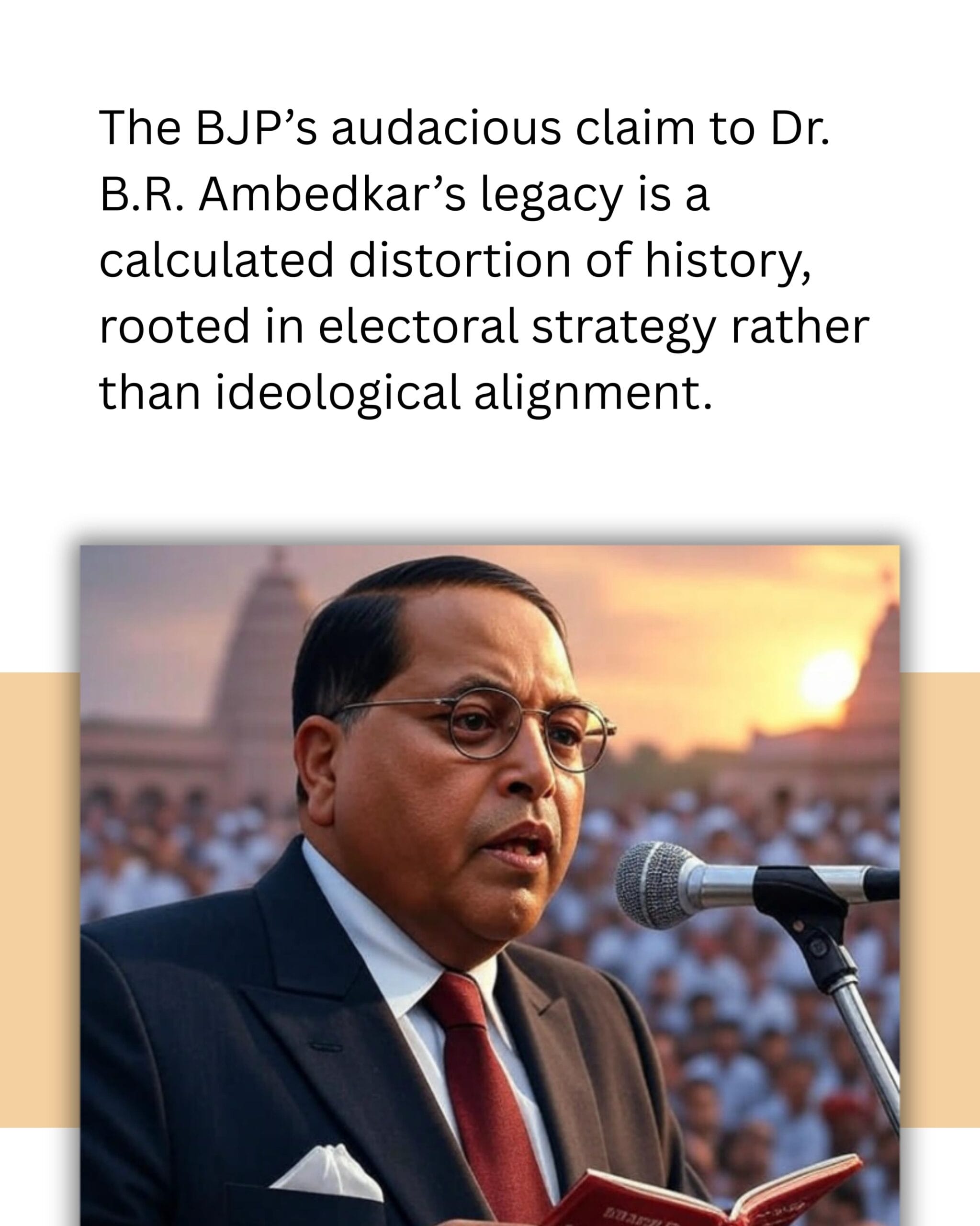
The BJP’s audacious claim to Dr. B.R. Ambedkar’s legacy is a calculated distortion of history, rooted in electoral strategy rather than ideological alignment. Historical evidence—from the RSS’s opposition to the Hindu Code Bill to Ambedkar’s critique of Hindu nationalism—reveals a fundamental disconnect between Ambedkar’s vision and the BJP’s Hindutva agenda. The party’s focus on symbolic gestures during Ambedkar Jayanti 2025, coupled with its selective historical narratives, betrays a lack of commitment to Ambedkar’s radical call for social justice. As India navigates its complex social and political landscape, Ambedkar’s legacy demands not appropriation but action—policies that dismantle caste, uplift the marginalized, and fulfill the constitutional promise of equality. The BJP’s claims, far from honoring Ambedkar, reduce his revolutionary legacy to a mere electoral tool.




No Comments