
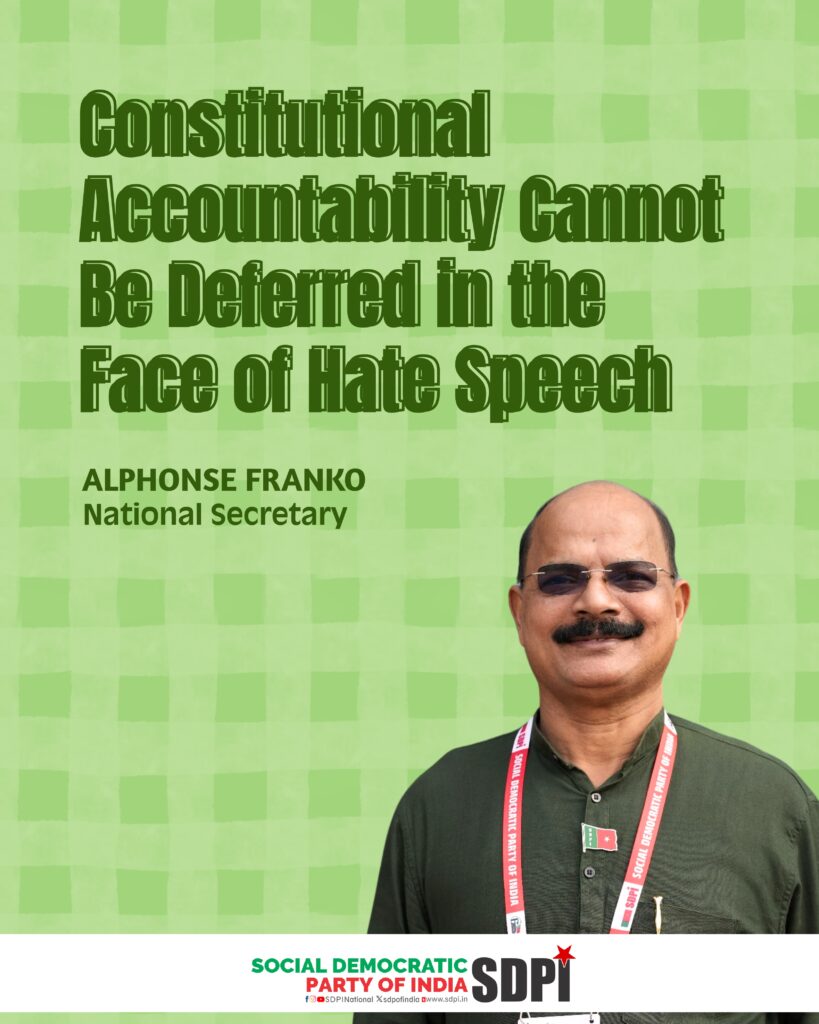
Constitutional Accountability Cannot Be Deferred in the Face of Hate Speech
Alphonse Franko, National Secretary of the Social Democratic Party of India, has expressed deep concern over the decision of the Supreme Court of India to return petitions related to repeated hate speech by Assam Chief Minister Himanta Biswa Sarma to the Gauhati High Court. He described the move as a troubling retreat from the Court’s constitutional responsibility at a time of heightened political sensitivity as Assam approaches assembly elections.
Referring to public speeches delivered in late January in Guwahati and Digboi, Franko noted that the Chief Minister openly declared his intention to make the Miya community suffer, encouraged the economic harassment of Muslim rickshaw drivers through deliberate underpayment, and spoke of removing large numbers of Muslim names from electoral rolls while portraying the community as outsiders unworthy of voting rights in Assam. He stated that these remarks, along with a now deleted AI generated video circulated by the Bharatiya Janata Party depicting violence against Muslim figures, amount to direct incitement to hatred and discrimination. Such actions, he said, fall within the prohibitions outlined in Sections 196 and 299 of the Bharatiya Nyaya Sanhita, 2023, which criminalise the promotion of enmity between religious communities and deliberate acts intended to outrage religious feelings.
Franko further observed that statements of this nature appear inconsistent with the constitutional oath taken under Article 164, which obligates the preservation of India’s secular framework and the protection of equal rights for all citizens. He warned that the consequences are already visible in intensified eviction drives, widening social boycotts, and selective deletion of voters, developments that undermine democratic participation for a significant section of Assam’s population.
While the Supreme Court characterised the direct approach to it as an attempt to bypass constitutional courts, Franko argued that this interpretation does not adequately reflect the seriousness of allegations involving a sitting Chief Minister repeatedly accused of deploying hate speech with apparent institutional backing. Situations of such urgency, he said, warrant the immediate protection of fundamental rights under Article 32. Referring the matter back to the Gauhati High Court in the prevailing political climate risks delay and raises legitimate concerns about the timely delivery of justice.

No Comments